

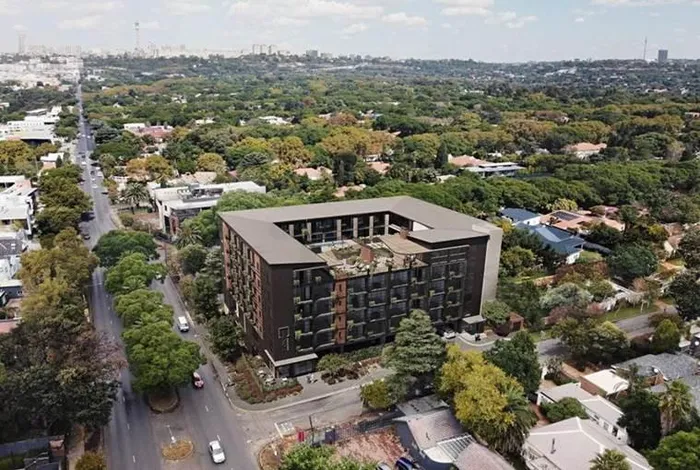
Rosebank’s position at the heart of the city’s corporate ecosystem allows residents to enjoy a vibrant urban lifestyle while remaining close to many of the country’s top employers.
Image: Supplied
In recent years, a combination of factors, including limited housing stock strained by Covid-era semigration and foreign buyers with stronger currencies, has pushed the premium of renting or buying a home in Cape Town to new heights.
It is against that backdrop that many young professionals are said to be opting out of Cape Town’s competitive property market in search of more money, and more value for it, in the City of Gold. The Wise Move 2025 Migration Report found that around 25% of people who left Cape Town last year relocated to Johannesburg, largely in pursuit of better career opportunities and fuelling a trend that some have dubbed "reverse semigration."
“Surveys by recruiters such as OfferZen suggest that young South African tech professionals in Johannesburg earn roughly 6% more than their counterparts in Cape Town, with similar trends in finance and corporate sectors - reflecting the city’s role as the country’s primary economic hub,” says Mark Stevens, the majority shareholder in the much-anticipated new Saxon Square development inRosebank.
‘Joburg’s most vibrant suburb’
Set to be completed in June 2026, the decision to locate Saxon Square in Rosebank is said to mark the confidence that Stevens, and Saxon Square’s other development partners have in what has been coined ‘Joburg’s most vibrant suburb.’
Rosebank appeal
“Rosebank has become increasingly appealing to young professionals relocating from Cape Town because it offers a similar lifestyle dynamic: mixed-use precincts, walkable streets and a strong café and restaurant culture. At the same time, its position at the heart of the city’s corporate ecosystem allows residents to enjoy a vibrant urban lifestyle while remaining close to many of the country’s top employers.”
A Cape Town lifestyle with Rosebank pricing
But while these ambitious young professionals want a neighbourhood that resembles Sea Point, they certainly cannot afford the same price tag.
The cost per m2 for a studio apartment in a new development on the Atlantic Seaboard can reach R73,000, almost double that of Saxon Square, where a 28m2 studio is priced from R1.04 million and despite both areas experiencing similar levels of demand.
Barrier to entry for first-time homebuyers in Cape Town remains extremely high
“The barrier to entry for first-time homebuyers in Cape Town remains extremely high, forcing many relatively well-paid professionals to spend the bulk of their income on rent rather than getting their foot on the property ladder,” Stevens says. “Our pricing model for Saxon Square is designed to respond to the growing demand from both these ‘reverse semigrants’ and local buyers for luxury lifestyle living that is still financially attainable.”
He points to the spike in demand for Rosebank as both a cultural and economic hub, as well as for this type of mixed-use development, as a key reason why WINK Aparthotels - well-known for managing four trendy aparthotel properties in the Western Cape, including WINK One Thibault - has chosen Saxon Square as the site of its first expansion into Johannesburg.
“Recognising the potential for high returns on being an early adopter in Rosebank’s growing short-term rental market, WINK offers buy-to-let investors a fully managed short-term rental solution, overseeing bookings, cleaning and maintenance while income from participating units is pooled and distributed proportionally among owners.”
In South Africa's case of late, parts of Cape Town have received much attention for expensive home prices, with the actual home value increases appearing to be a mounting problem, said John Loos, an independent economist earlier this week. He says there are estimates of high levels of foreign buying, a “semi-grant” influx, and high levels of investment in short term rental properties in and around the City Bowl and Atlantic seaboard.
“These factors are all believed to be contributing to driving up prices beyond the reach of many locals.This is exacerbated by severe land shortages, with the sea on one side and the mountain on the other."
"But for South Africa as a whole, has average home 'in-affordability' really become worse over the past few decades? Using the long history of the since-discontinued Absa House Price Index and linking it to the more recently established StatsSA House Price Index, the perception of a sharp deterioration in home affordability needs to be interrogated.”
More than R70 million in sales within the first ten weeks
With Saxon Square achieving more than R70 million in sales within the first ten weeks of launch, it’s clear that Stevens and his development partners have tapped into what today’s young professional buyers are looking for.
He notes that the mixed-use developments that succeed are those that combine a sense of community with everyday convenience.
Key amenities include:
•Proximity to public transport hubs and shopping centres
•24-hour concierge services to manage deliveries and visitor arrivals, much like the doorman services found in leading New York high-rises
•Smart security features such as biometric access control
•Community-focused spaces including communal braai areas, lounges, eateries and cinemas
•Co-working facilities to support remote workers and digital nomads
•Wellness amenities such as a meditation garden, yoga studio and rooftop gardens
“What buyers are really looking for is a sense of community, convenience and access to opportunity in one place. When a development offers that combination, demand tends to follow,” Stevens says.