

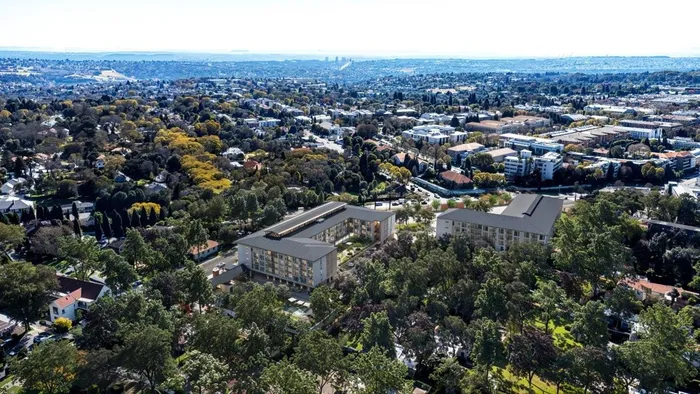
Investors have become far more discerning as they want a credible node, a product that stays desirable over time and numbers that reflect genuine demand.
Image: Supplied
Construction is underway and three mock units are now ready for viewing at 50 Jameson Avenue as Craft Homes has officially opened sales for Iconic Melrose.
Positioned in one of Johannesburg’s most resilient, supply-constrained urban nodes, Iconic Melrose is said to be launching into a market where buyers increasingly want lifestyle convenience and investment logic to sit comfortably in the same purchase.
“The timing also reflects a broader shift in how urban buyers are choosing to live,” says Craft Homes Development manager, Lubbe Kruger.
“In the Rosebank–Melrose–Illovo corridor, apartments have become the dominant way people access these premium, well-connected neighbourhoods. With limited new stock coming to market in established nodes, demand tends to concentrate around developments that can offer both security and proximity to the city’s strongest work-and-play ecosystems.”
The residential developer says home-loan affordability is back in the spotlight, not only because rates have eased, but because the South African Reserve Bank has opened a debate on scrapping the prime lending rate as a key reference point in financial contracts, in favour of a clearer link to the policy rate.
“Against that backdrop, buyers are placing a premium on certainty: developments where the product is visible and construction progress is real.”
Set minutes from the Gautrain and within easy reach of Rosebank, Illovo and Sandton, Iconic Melrose offers a mix of contemporary studios (33–36m²), two-bedroom apartments (65–95m²) and three-bedroom apartments (105–153m²), with prices starting from R1.259 million.
Kruger adds that Melrose has consistently held its value because it is anchored by real demand around major business districts, top schools and hospitals, and the kind of retail and leisure infrastructure that makes day-to-day life effortless.
Iconic is designed to meet that demand with a product that’s both liveable and investable.
That thinking is said to show up in the building’s layout. The team deliberately moved away from the traditional apartment-block formula of narrow passages and long, dimly lit corridors, introducing a central atrium instead.
The atrium draws natural light deep into the building and creates space for greenery and trees at first floor level, shifting the feel from enclosed to expansive.
The materials used in its construction also allow the building to operate approximately 2% cooler, a subtle but meaningful efficiency gain for long-term investors.
Beyond the atrium sits a landscaped deck with a gym, coffee shop and clubhouse.
The design borrows inspiration from high-end retail environments, where volume and openness shape the experience: “Think running on a treadmill while overlooking planted gardens rather than a blank wall. We do not want the development to look like a cookie-cutter hotel.”
The residential developer says Iconic’s appeal is designed to work on two levels. For residents, it says it’s a lock-up-and-go lifestyle supported by landscaped gardens and walkways, a pool house, children’s play areas, a fitness facility, a coffee bar and co-working space, and 24-hour access-controlled security with off-site monitored CCTV.
Units are described as fibre-ready, including smart prepaid water and electricity metering and offer essential solar backup, with environmentally friendly building features built into the estate’s design.
For investors, the development is said to enter the market as rental demand remains strongest in connected nodes that offer convenience, security and proximity to employment.
Strong interest is expected from professionals seeking access to Sandton, Rosebank and Johannesburg’s leading commercial hubs.
“Investors have become far more discerning. They want a credible node, a product that stays desirable over time and numbers that reflect genuine demand. When a neighbourhood consistently outpaces supply, you’re buying into scarcity and long-term occupancy rather than speculation.”
Iconic’s investor materials are said to indicate blended gross yields of 11.1% and net yields of 7%, with selected units reaching gross yields up to 12.1%, alongside average annual rental growth of 6.4%.
The construction is scheduled in two phases, with Phase 1 expected to be completed in the first quarter of next year (2027) and Phase 2 in the last quarter of next year.
According to the Rainmaker Marketing latest Rainmaker Marketing Property Market Report for Sandton, Rosebank and surrounding nodes which recently went live, the findings highlighted that Sandton Central and Rosebank as core functional urban nodes, emerging as key pockets of resilience and investment within Gauteng’s residential market.
The reports said that in addition to being South Africa’s most populous province, Gauteng is an economic engine for the country, driven by scale, sectoral strength, investment flows and coordinated planning.
• Contributes 33% of SA’s GDP, more than WC (14%) and KZN (16%) combined.
• Accounts for 30% of total employment in SA.
• Top 3 economic growth sectors: finance, personal services, utilities.
According to the report, Gauteng added 102,000 jobs YoY (Q4 2024 – Q4 2025), the total property sales value increased by 30% while total property volume was up by 20%.
The average value per sale was said to be up by 3.5%
Since 2023, the agency says the average price p/m2 across Sandton and Rosebank has increased by 16% for older stock and 29% for newer developments. “These trends are influencing where people choose to live, invest and develop property.”
Independent Media Property