

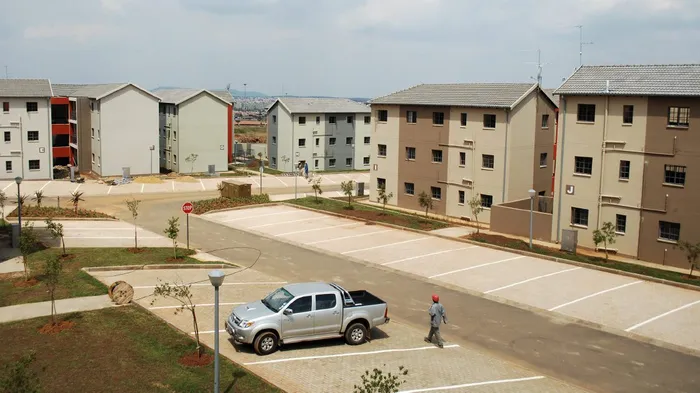
Purpose-built, professionally-managed, well-located multifamily rental housing accomplishes what the government seeks to achieve: improving lives with quality housing that also provides access, opportunity and amenity.
Image: Tiro Ramatlhatse
For many low-and moderate-income families, home ownership is not immediately within reach.
More importantly, the South African Multifamily Residential Rental Association (SAMRRA) members report that, increasingly, their residents are choosing to rent, actively seeking a balanced lifestyle in amenity-rich, well-located rental homes, says Palesa Mkhize, the CEO of SAMRRA.
South Africa is a rental nation, Mkhize says. “Approximately 4.5 million (23%) households rent their homes, according to a 2025 report compiled by the Centre for Affordable Housing Finance (CAHF) with SAMRRA. 15% or around 685,000 households, reside in ’apartments’.
"In the face of growing (and unmet) demand, 54,000 new rental units were added to the market over five years, a 9% increase, positioning multifamily rentals as a cornerstone of modern housing solutions.”
Affordability remained a major challenge for South Africa’s homebuyers last year.
“Many buyers simply didn’t qualify for the bonds they were hoping for,” said Leonard Kondowe, the national manager for Rawson Finance.
“The rate cuts we’ve seen this year helped, but they weren’t a silver bullet – especially with high living costs eating into disposable income.”
Lightstone recently told "Independent Media Property" that its data shows a typical transacting “middle” clustering around R500k to R2m, with an average sale price of R1.3m.
“Lightstone gives a salary benchmark of R27k(pm) to service a R750k bond,” the property information, valuations and market intelligence provider said recently.
SAMRRA, which represents privately owned residential stock, designed specifically for renting rather than for sale, says it welcomes President Cyril Ramaphosa’s announcement in the State of the Nation Address outlining a new housing model that expands affordable housing and shifts support to include rental subsidies.
The President stated, “We are introducing a new model for housing, where people are given subsidies for ownership and rental in areas that are suitable for them. We are shifting from building houses for people to supporting them to build, buy or rent their own housing.”
“The President’s announcement signals an important shift: the realisation that rental housing is not a secondary option. It is central to economic participation,” Mkhize says.
This policy direction reflects economic reality and the lived experience of millions of South African households.
The announcement of the new housing model also acknowledges that households must have the option of living in areas that are suitable for them, SAMRRA says.
Research undertaken by the Green Building Council South Africa (GBCSA) and SAMRRA member Divercity Property Fund in 2025, plainly shows that well-located, resource-efficient housing boosts access to jobs and education, reduces transport costs, enhances the sustainability of SA cities, and improves long-term asset performance.
“Location is not a luxury,” says Mkhize. “It determines whether a household can access work and manage the daily cost of living. You can’t just build housing. You need to think carefully about what you’re building, where you’re building it and who you’re building it for.
"When families live closer to employment nodes and reliable public transport, we reduce the hidden cost of working and increase the potential for more South Africans to thrive.”
Multifamily residential rental property continues to demonstrate its strength as one of South Africa’s most resilient and compelling real estate opportunities, underpinned by vast demand and growing institutional participation, says the representative body.
It says demand is strongest where access to opportunity is greatest and, for this reason, SAMRRA members prioritise housing in well-located urban nodes close to employment, transport and social infrastructure.
This includes, among many others, properties at the gateway to Sandton Central, in Sunninghill, Bryanston and in Menlyn in Gauteng, as well as in the Cape Town CBD, Salt River and Pinelands in the Western Cape, it adds.
“Multifamily rental housing is a resilient and compelling investment and, when done right, it also offers a high-impact economic and social strategy,” notes Mkhize. “This announcement by the President recognises that rental housing is a core pathway to opportunity for working South Africans.”
SAMRRA members manage a growing number of more than 75,000 rental units across approximately 550 properties.
These are institutionally financed, professionally managed developments operating within clear governance frameworks. Their performance is measurable and auditable. This positions the sector to administer income-linked rental subsidies efficiently and accountably.
It adds that the state does not need to start from scratch. The multifamily rental residential model is proven in South Africa, as it is abroad. The infrastructure already exists. The capital is active. The delivery pipelines are operating.
“Purpose-built, professionally-managed, well-located multifamily rental housing accomplishes what the government seeks to achieve: improving lives with quality housing that also provides access, opportunity and amenity.
“SAMRRA stands ready to engage on the new subsidy framework and bring the might of our members to meaningful, measurable and market-ready solutions that deliver momentum. The opportunity is clear: leverage existing institutional capacity to scale rental housing that works for families and for the economy.”
Last week, we reported that elevated administered prices, particularly electricity, water and municipal charges, continued to place pressure on household budgets, both tenants and homeowners.
This was even as headline inflation had eased, Siphamandla Mkhwanazi, a senior economist at FNB, said last week.
“Maintenance costs have also remained high due to the above-mentioned inflation increases in materials and service costs.
"In response, households have adjusted through a combination of cost‑containment strategies, including downsizing, deferring non‑essential maintenance, increased sharing of accommodation, and heightened price sensitivity when selecting rental or purchase options,” Mkhwanazi said.
Independent Media Property