

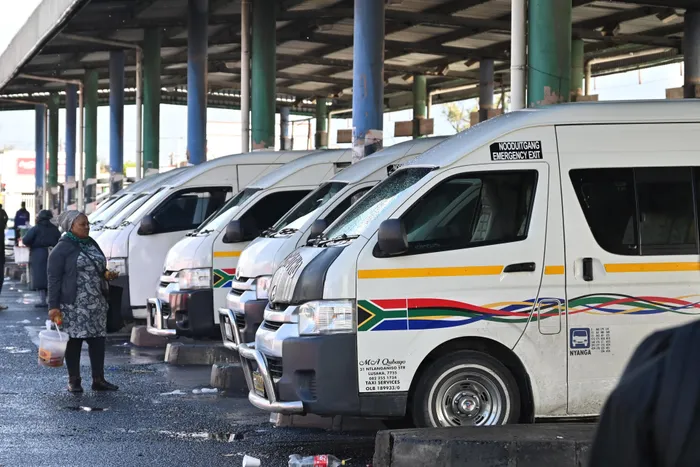
The Organisation Undoing Tax Abuse (OUTA) and the Democratic Alliance (DA) have alleged that most taxi operators do not pay corporate tax, VAT or payroll taxes, citing the industry's predominantly informal, cash-based business model.
Image: Ayanda Ndamane / Independent Media
One of South Africa's largest industries, estimated to generate around R100 billion annually, is under renewed scrutiny over claims that it operates largely outside the country's tax system.
The Organisation Undoing Tax Abuse (OUTA) and the Democratic Alliance (DA) have alleged that most taxi operators do not pay corporate tax, VAT or payroll taxes, citing the industry's predominantly informal, cash-based business model.
According to reports, most taxi fares are paid in cash, with operators seldom issuing receipts or maintaining formal financial records, making tax collection difficult.
Speaking to the SABC earlier this year, OUTA CEO Wayne Duvenage said broadening the tax base to include informal sectors such as the taxi industry could generate significant additional revenue for the state.
"So, we've got a lot of informal industries and the taxi industry that is not within the tax base. If you just go and start doing that, start slowly, we should be able to get R2 billion a year, build that up to about R9 billion per annum going forward," Duvenage said.
He added that the proposal was not intended to penalise the taxi industry but to formalise businesses that are already operating at scale.
The South African National Taxi Council (SANTACO), however, has rejected claims that the industry does not pay tax, describing the perception as "misguided and shallow".
SANTACO spokesperson Mmatshikhidi Rebecca Phala said most taxi operators are registered as sole proprietors and pay personal income tax rather than company tax.
She said operators receive tax clearance certificates from the South African Revenue Service (SARS), which are required when applying for or renewing operating licences.
Phala acknowledged that the current tax framework does not adequately cater for the informal structure of the taxi industry and called for reforms to address the existing taxation loophole.
She added that taxi operators should not be treated in the same way as public companies, as the industry is made up of individual business owners organised through taxi associations.
IOL Business