

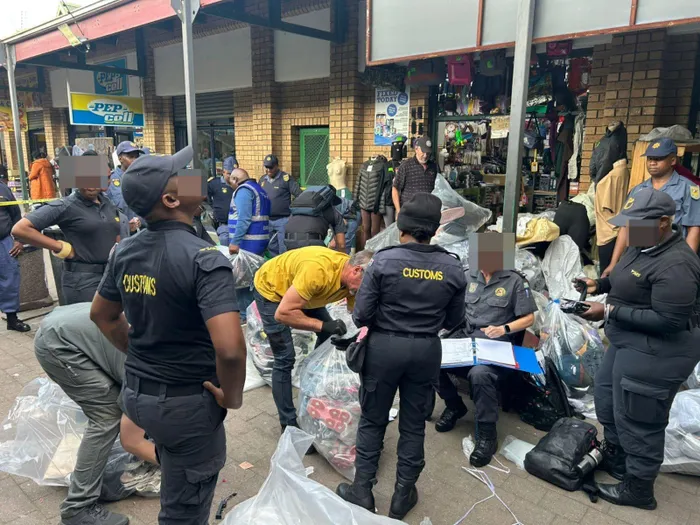
South African authorities have escalated efforts to combat illicit trade, warning that illegal goods continue to erode the economy, cost jobs and undermine legitimate businesses.
Image: SARS
South African authorities are intensifying enforcement against illicit trade, with the South African Revenue Service (Sars) and other agencies seizing goods worth an estimated R245 million in North West raids as government moves to curb smuggling, counterfeits and tax evasion.
South African authorities have escalated efforts to combat illicit trade, warning that illegal goods continue to erode the economy, cost jobs and undermine legitimate businesses.
The Sars, working with other state agencies, recently seized goods valued at an estimated R245 million during coordinated operations across parts of the North West province.
More than 170,000 items were confiscated in raids conducted in Rustenburg, Brits, Marikana and Hartbeespoort.
Sars said the operation forms part of an ongoing crackdown on smuggling, counterfeit goods and tax evasion. Several businesses have also been flagged for further investigation as authorities move to dismantle illegal supply networks.
President Cyril Ramaphosa has previously warned that illicit and counterfeit goods are damaging the economy and contributing to job losses and weakened local industry.
Tobacco, alcohol and branded clothing remain among the most commonly counterfeited and illicitly traded goods in South Africa.
According to research from the University of Cape Town’s Research Unit on the Economics of Excisable Products (REEP), illegal cigarettes accounted for about 60% of sales in 2021, rising sharply after the Covid-19 sales ban in 2020 from around 30%.
The study found that the illicit cigarette market has remained at elevated levels since then.
British American Tobacco South Africa (BATSA) has also indicated it is exiting local production, citing the “devastating impact” of the illicit cigarette trade, with its Heidelberg manufacturing facility in Gauteng expected to close by the end of 2026.
Illicit trade is estimated to cost the South African economy as much as R100 billion annually, with the illegal economy believed to account for around 20% of GDP.
During his State of the Nation Address (SONA), Ramaphosa said government is establishing a national illicit economy disruption programme to coordinate efforts across state agencies and the private sector.
He said the initiative will use data analytics and artificial intelligence to target high-risk sectors including tobacco, fuel, alcohol and counterfeit goods, while strengthening enforcement and speeding up investigations.
Ramaphosa also stressed that the crackdown is aimed not only at recovering lost revenue, but also at protecting jobs and stabilising the economy, warning that organised crime poses a serious threat to South Africa’s development and democracy.
Parliament has also backed stronger action. Chairperson of the Standing Committee on Finance, Joe Maswanganyi, said illicit trade requires urgent and coordinated intervention across government departments.
He said Parliament will engage Sars, the Border Management Authority and police to strengthen enforcement.
“This is a serious matter, causing damage to the economy of the country. Our committee will engage with Sars, the Border Management Authority and the police. This is a matter that needs a multidisciplinary approach; it needs all of us to find a solution.”
IOL