

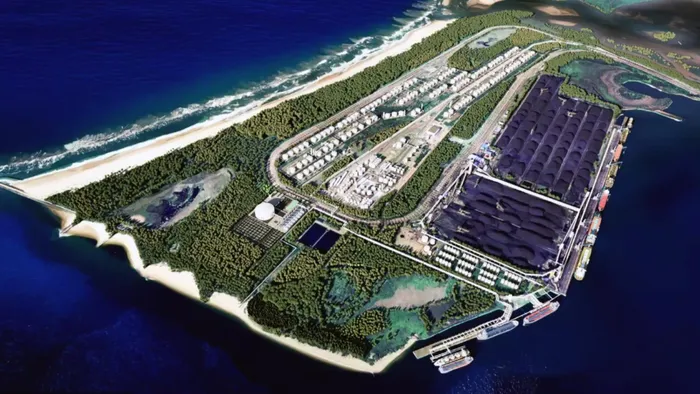
South Africa has taken another step forward in plans to develop its first liquefied natural gas (LNG) import terminal
Image: Supplied
South Africa has taken another step forward in plans to develop its first liquefied natural gas (LNG) import terminal at the Port of Richards Bay.
The move comes as the country faces a possible gas shortage, with supply from Mozambique’s Pande and Temane fields expected to decline as they near the end of their life. The gas is currently transported to South Africa through the ROMPCO pipeline.
The project, which is still in its early stages, is aimed at securing future energy supply by allowing LNG to be imported by ship, stored, and turned back into gas for use in power stations and industry.
Earlier this week, the Zululand Energy Terminal (ZET) signed early agreements with ExxonMobil and power utility Eskom. Eskom is expected to be a key buyer through its planned gas-to-power programme, while ExxonMobil’s involvement points to possible LNG supply support.
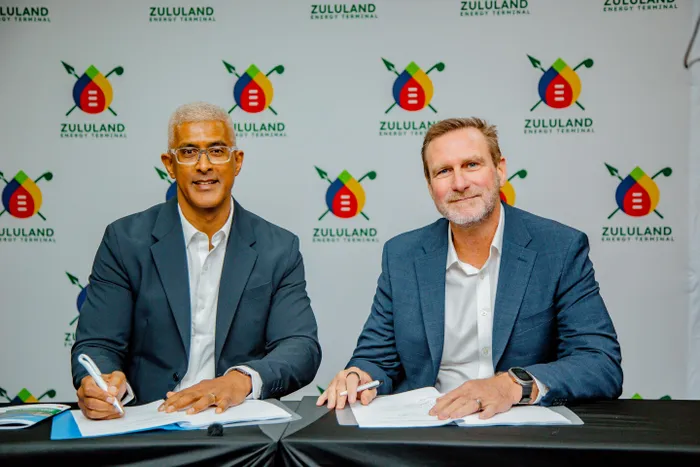
Oliver Naidu, Director of Zululand Energy Terminal, and Andrew Barry, Chairman of ExxonMobil LNG Market Development Inc., sign the Heads of Agreement that advances the development of South Africa’s first liquefied natural gas (LNG) import terminal at the Port of Richards Bay.
Image: Supplied
ZET Director Oliver Naidu said the project is an important step in building South Africa’s future gas system and supporting long-term energy security.
"This project, for us, represents hope for the future. It is a legacy project, underpinning sustainable growth, that will benefit generations ahead of us," Naidu said.
Naidu said the project will be developed in phases, starting with a floating storage unit and onshore regasification infrastructure to enable initial operations and future expansion as demand grows.
"Phase one is expected to include a floating storage unit of at least 170,000 cubic meters and an onshore re-gasification system with an indicative capacity of approximately 3 million tons per annum, or around 400 million standard cubic feet per day".
He added that a second phase will expand storage and increase capacity to about 4.5 million tons a year as demand grows.
"The LNG will be safely stored, regasified through onshore technology, and then distributed through pipeline infrastructure to customers. A key part of the system is the planned gas transfer point within the Richards Bay Industrial Development Zone," he said.
"This will serve as a central offtake and distribution node, enabling gas to be supplied to multiple users in the region, including industrial customers and future gas-to-power developers".
He said ZET plans to invest about R 35 million in skills development over the life of the project, including R 17 million during construction and R18 million during operations.
The programme is expected to benefit around 800 people, with a focus on youth, women, and persons with disabilities in the region.He added that the project targets 40% local participation during construction and 60% during operations.
Executive Mayor Councillor Xolani Ngwezi welcomed the investment, saying it could create jobs and opportunities across the broader value chain.
"The injection of R15 billion will create no fewer than 800 jobs, as well as opportunities across the value chain. We really can't wait for that. The project is going to be a game-changer for our area and for economic growth in Richards Bay"
He said investors should engage communities on the skills that will be needed in future so that local residents can be trained and prepared for employment opportunities created by the project.
“You can't destroy something that serves you. That is why it is important for investors to share the skills that will be needed in the future so that local people can be trained and equipped with skills that match the needs of the job market,” Ngwezi said
IOL Business