

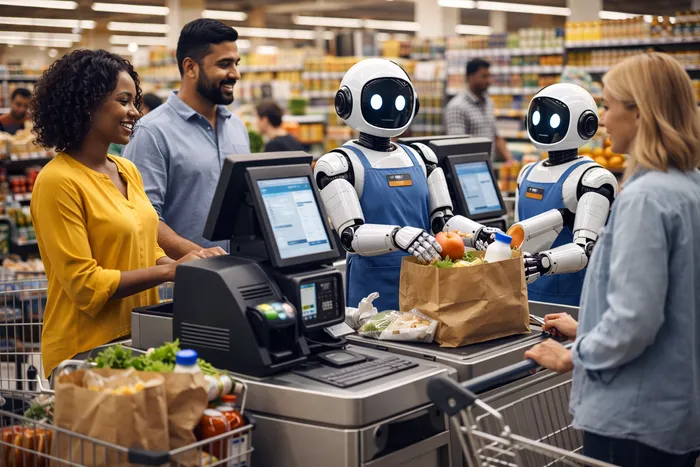
Self-serve checkouts are a growing phenomenon across the globe.
Image: ChatGPT
Across supermarkets globally, self-checkout counters are becoming a familiar sight as retailers adopt automation to speed up queues and reduce operating costs. Customers scan their own groceries, bag them and pay without interacting with a cashier.
The spread of automated checkout counters has become one of the most visible signs of technology reshaping everyday retail internationally, and these till points are making an appearance in South Africa too, with companies such as Checkers, Woolworths, Decathlon, Zara and KFC all implementing the technology to one extent or another.
The Payments Association notes that self-checkout, which first appeared in 1984, has grown to the point where 96% of grocery stores in the UK are kitted out with these kiosks
In Germany, GK Software noted that the number of stores with fixed self-service checkouts increased 143% between 2023 and 2025.
Consumers also seem to prefer serving themselves, with surveys noting a preference for self-checkout from about 60% of shoppers.
Artificial intelligence is clearly making a mark on the retail sector. Research by ServiceNow and workforce technology experts Pearson, cited by Retailbiz, found that retail is expected to be among the most affected industries in the shift to automation, with nearly one-quarter of current retail jobs likely to be taken over by robots.
Understandably, this has raised concerns about job protection, especially given that automation brings with it productivity benefits that help cut costs.
The South African retail sector employs more than three million people, according to Statistics South Africa, making it one of the largest sources of formal and informal work. Most of the jobs are at the lower end of the wage scale – and easily replaceable by robots.
In an environment where unemployment is officially 31.4% and probably closer to 40% in reality, unions have strongly opposed tills that do away with staff.
Retailers have, however, stated that these systems are meant to augment staff, not necessarily replace them, with employees often redeployed to act as "concierge assistants".
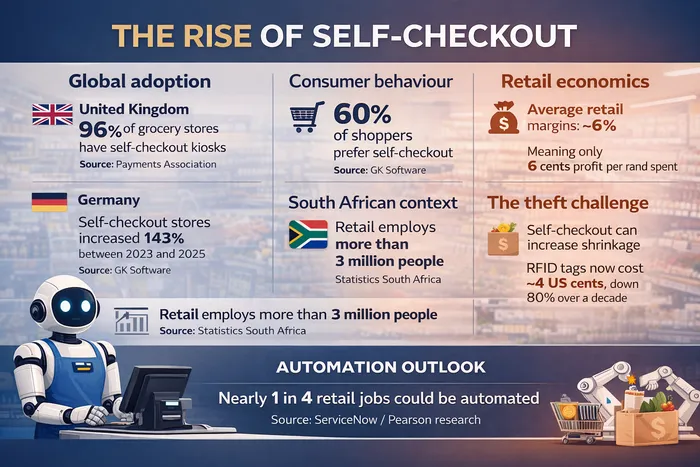
The rise of self-service in numbers.
Image: ChatGPT
It is difficult to tell what the full impact of this technology – and AI in general – will be, not least because the forecasts keep shifting as AI matures.
More than a decade ago, McKinsey said that less than 5% of occupations could be fully automated using then-current technologies, though about 60% of occupations could have 30% or more of their constituent activities automated.
Automation, it concluded, was likely to change the vast majority of occupations – at least to some degree – necessitating significant job redefinition and a transformation of business processes.
Fast forward to 2023, and the World Economic Forum stated that nearly a quarter of all jobs globally would change in the next five years.
Across 45 economies covering 673 million workers, it projected a net decrease of 14 million jobs – or 2% of current employment.
By last year, the picture had shifted again. The WEF's Future of Jobs Report said this decade would see the creation of 170 million new jobs, offset by the displacement of 92 million positions – resulting in a net increase of 78 million jobs.
Retail, the forecasters suggest, could yet be one of those industries where new technology results in workers being upskilled rather than replaced.
One of the drivers of that upskilling push is, counterintuitively, because people steal. Nexford University noted that while allowing customers to scan their own items can increase instances of theft, companies often find they still save money by reducing the need for employees at registers.
Theft is among the reasons retailers cite – off the record – for why self-checkout is not always the best idea. Radio-frequency identification (RFID) tags, like the ones staff deactivate when scanning high-shrinkage items, have previously been prohibitively expensive.
The items people are most likely to walk out with are small – razors, batteries – making stock protection a costly exercise. However, the cost of RFID tags has dropped some 80% over the past decade, to as little as 4 US cents (about 65c).
South African retailers also operate on razor-thin margins of around 6% – meaning just 6c of every rand spent is net profit after operating expenses.

Theft is a common issue with till points that aren't staffed.
Image: ChatGPT
Desktop research further shows that retailers commonly staff self-checkout areas with employees supervising multiple machines at once, intervening when systems flag issues and assisting customers.
This is another pressure point: retailers are acutely aware that they do not want to be seen causing job losses. Because of this, many supermarkets continue to operate a mix of automated and staffed tills rather than eliminating cashiers entirely.
There is a practical argument on that side too. Machines malfunction and need human intervention – and in the meantime, consumers continue to queue.
And, there's a kicker.
There is, in fact, a small yet noticeable shift back to tills staffed by actual people. The UK's Booths supermarket removed self-checkout at almost all its outlets after shoppers made clear they wanted human interaction – a reminder that the future of retail may not be as automated as the headlines suggest.
IOL BUSINESS