

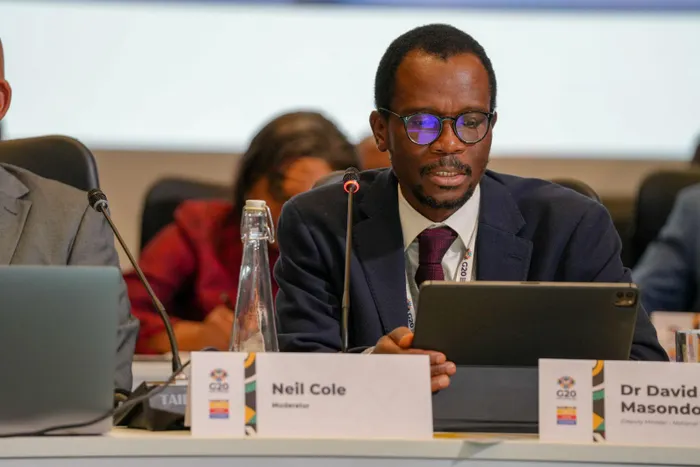
Deputy Finance Minister David Masondo on Thursday resigned as chairperson of the Public Investment Corporation (PIC) board. The writer argues that the current public debate surrounding the PIC presents an opportunity to elevate the conversation beyond individual appointments.
Image: GCIS
Parmi Natesan
Recent public debate surrounding governance at the Public Investment Corporation (PIC) has focused on individuals and appointments. While these are matters for the relevant appointing authorities and the applicable legislation, the discussion presents an important opportunity to reflect on broader governance principles that extend well beyond a single organisation.
The Institute of Directors in South Africa (IoDSA) believes that the debate should centre on two fundamental questions. First, what level of independence should be expected of the chairperson of a governing body? Secondly, what competencies should be expected of those entrusted with leading the boards of institutions that manage assets of significant public importance?
These are not merely theoretical questions. They go to the heart of public confidence in the governance of South Africa's institutions.
King V recommends that the chairperson of a governing body should be an independent non-executive member.
The chairperson is responsible for leading the governing body in the objective, ethical and effective discharge of its governance responsibilities. The chairperson shapes board culture, facilitates robust debate, encourages constructive challenge, manages board dynamics and helps ensure that decisions are taken in the best interests of the organisation.
King V provides that independence should be assessed objectively, considering whether any interest, position, association or relationship would, from the perspective of a reasonable and informed third party, be likely to unduly influence or create bias in decision-making.
This is particularly important in the public sector, where boards often operate within legislative appointment frameworks. While enabling legislation may prescribe how appointments are made, good governance requires careful consideration of how governance arrangements support objective decision-making and public confidence.
Equally important is the question of competence.
King V identifies competence as one of the core characteristics expected of every member of a governing body. This includes acquiring sufficient knowledge of the organisation, its industry, applicable legislation and governance responsibilities, exercising due care, skill and diligence, and continually developing governance competencies.
Furthermore, King V requires that governing bodies be composed with an appropriate mix of competencies, diversity and independence to enable them to discharge their responsibilities effectively. It also emphasises the importance of succession planning, director induction and ongoing professional development.
Chairing a governing body is a specialised leadership role. It requires considerably more than technical expertise or experience in another field. Effective chairs must be capable of facilitating independent debate, building consensus where appropriate, holding executive management to account, managing conflicts constructively and ensuring that the governing body functions as an effective collective.
Appointment to political office should not, in itself, be regarded as evidence of competence to chair a governing body. Chairing one of South Africa's most significant public institutions requires specialised governance capabilities that are developed through experience, training and the continual application of sound governance principles. The same standard should apply irrespective of whether appointments are made in the public or private sector.
As South Africa continues to professionalise directorship and strengthen governance across both the public and private sectors, greater attention should be given to ensuring that those appointed to chair strategically important institutions possess not only integrity and experience, but also the governance competencies necessary to fulfil the role effectively.
The current public debate presents an opportunity to elevate the conversation beyond individual appointments. Ultimately, good governance depends not only on who serves on a governing body, but on whether those individuals possess the independence, competence and governance capability required to discharge one of the most important responsibilities in public life.

Parmi Natesan. Parmi Natesan is the CEO of the Institute of Directors in South Africa (IoDSA).
Image: Supplied
* Parmi Natesan is the CEO of the Institute of Directors in South Africa (IoDSA).
** The views expressed do not necessarily reflect the views of IOL or Independent Media.
BUSINESS REPORT