

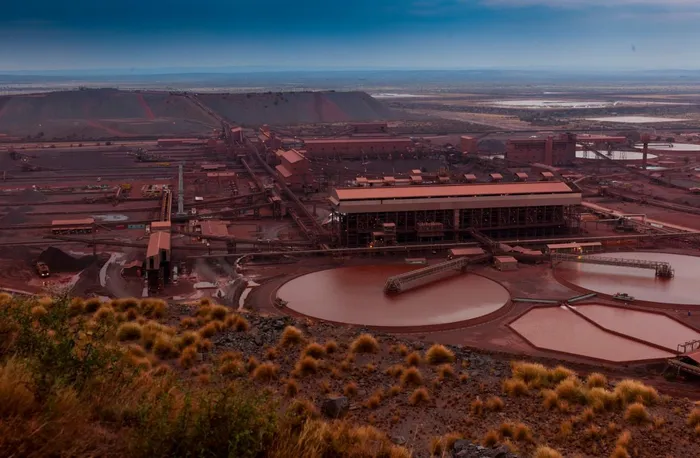
Sishen mine near the town of Kathu in the Northern Cape province is Anglo's flagship operation and one of the largest open pit mines in the world – some 14km long. The bulk of Anglo's iron ore production comes from Sishen mine, with most of it being exported.
Image: Supplied
Kumba Iron Ore has taken another step towards decarbonising its operations after signing an energy offtake agreement with Envusa Energy for a 63MW embedded solar photovoltaic plant at its flagship Sishen mine in the Northern Cape.
The agreement, announced on Thursday, will see the on-site solar facility begin supplying electricity to the mine in the fourth quarter of 2027.
Kumba said the project would displace about 35% of Sishen's current Scope 2 carbon emissions once fully operational, supporting the company's target of reducing greenhouse gas emissions by 28% by 2030, based on its 2020 emissions baseline. The initiative also contributes to parent company Anglo American's 2030 climate commitments.
The project is the first embedded renewable energy development to reach this stage under the Envusa Energy programme, a joint renewable energy venture established to help power Anglo American's South African operations.
Sishen mine near the town of Kathu in the Northern Cape province is Anglo's flagship operation and one of the largest open pit mines in the world – some 14km long. The bulk of Anglo's iron ore production comes from Sishen mine, with most of it being exported.
The announcement follows the completion of Envusa's Koruson 2 cluster, comprising the 240MW MooiPlaats Solar PV project and the 140MW Umsobomvu and 140MW Hartebeesthoek wind farms in the Eastern and Northern Cape provinces.
The Sishen solar facility will be built on top of the mine's existing G80 waste rock dump, transforming previously disturbed mining land into renewable energy infrastructure.
According to Kumba, the project required innovative engineering solutions to overcome complex geotechnical conditions while repurposing the site into productive energy-generating infrastructure.
The plant will have an installed capacity of 72.5MWp DC, delivering 63MW AC to the mine. Kumba said the project was sized to maximise cost savings over its lifespan.
Once operational, the project will lift Kumba's renewable energy penetration to approximately 45%, including the 11MW of wheeled renewable electricity already being supplied to its Kolomela mine through Envusa's Koruson 2 cluster since March 2026.
Beyond reducing emissions, Kumba said the development was designed to deliver economic benefits to surrounding communities through employment, skills development and opportunities for local businesses during construction and operation.
A key feature of the project is the participation of the Sishen Iron Ore Company Community Development Trust, which will hold a 10% equity stake in the solar facility.
The mining company said dividends generated from the long-life renewable energy asset would be reinvested into community development initiatives, including education, healthcare, infrastructure, job creation, skills development and sustainable livelihoods.
Kumba CEO Mpumi Zikalala said the project strengthened the company's transition towards lower-carbon mining while improving energy security.
"The Sishen solar PV project is designed to deliver reliable, cost-competitive renewable energy and, together with Kolomela, which has been receiving 11MW in wheeled renewable energy since March 2026, strengthens the pathway to a lower-carbon future," Zikalala said.
"The project advances our ambition to reduce greenhouse gas emissions by 28% by 2030 and supports Anglo American's 2030 climate target."
Mining companies across South Africa have accelerated investments in renewable energy in recent years as they seek to reduce exposure to rising electricity costs, improve supply reliability and meet increasingly stringent environmental, social and governance (ESG) commitments.
The embedded solar project also aligns with broader industry efforts to repurpose mining infrastructure and land for renewable energy generation, supporting South Africa's just energy transition while creating shared economic benefits for host communities.
BUSINESS REPORT