

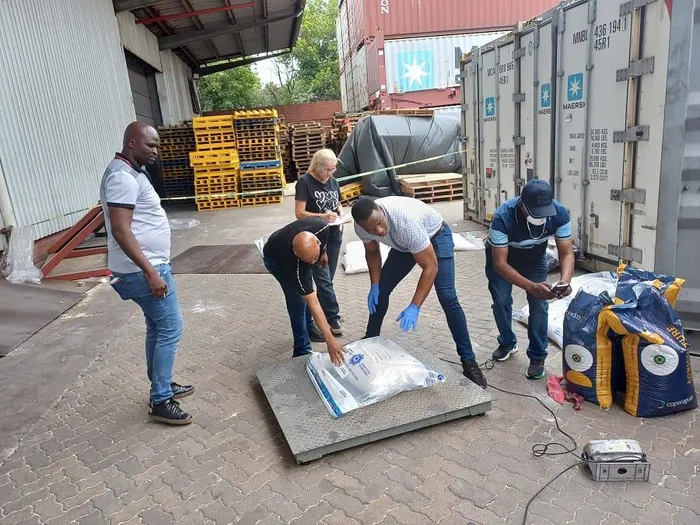
The UN agency warned that drug traffickers are becoming increasingly innovative, creating new synthetic substances, diversifying trafficking routes and targeting emerging markets across Africa, Asia and the Middle East.
Image: SAPS
Global drug markets are undergoing a rapid transformation, with organised crime groups exploiting new technologies, geopolitical instability and the emergence of powerful synthetic drugs to expand into new markets, according to the United Nations Office on Drugs and Crime (UNODC).
In its World Drug Report 2026 released on Friday, the UN agency warned that drug traffickers are becoming increasingly innovative, creating new synthetic substances, diversifying trafficking routes and targeting emerging markets across Africa, Asia and the Middle East.
UNODC executive director Monica Juma said the world was witnessing an unprecedented surge in new drugs, many of which are more potent and dangerous than traditional narcotics.
"We have seen an unprecedented spike in new types of drugs on the market, and worryingly, some are more potent or dangerous than before," Juma said.
"And, we are already suffering the impact: millions of premature deaths and healthy years of life needlessly lost; drug trafficking networks that are distorting economies; the destruction of lives, communities and livelihoods; and the compounding of insecurity and violence."
Juma said governments needed to intensify efforts against organised crime syndicates through stronger intelligence sharing, coordinated law enforcement operations and greater investment in prevention and treatment programmes.
According to the report, an estimated 331 million people used drugs in 2024, representing 6.2% of the global population aged between 15 and 64. This marks a significant increase from 5.2% a decade earlier.
Cannabis remained the world's most widely used drug, with an estimated 256 million users in 2024, followed by opioids with 63 million users, amphetamines at 32 million, cocaine at 25 million and ecstasy at 21 million.
The report found that illicit drug manufacturers are increasingly developing synthetic drugs to evade regulations and law enforcement. The number of different drug types detected in seizures in 2024 was five times higher than before 2000.
A total of 755 new psychoactive substances were circulating globally in 2024, including 118 substances identified for the first time.
UNODC also highlighted a major shift in the global opioid market following Afghanistan's 2022 ban on opium cultivation, which has sharply reduced heroin production.
Although Myanmar increased opium production to more than 1,000 tons in 2025, this remains far below Afghanistan's output of more than 6,000 tons before the ban.
The report warned that traffickers are increasingly turning to synthetic opioids such as fentanyls, nitazenes and orphines as alternatives to heroin, potentially leading to a permanent transformation of the global opioid market.
Methamphetamine has also become a truly global drug, with new trafficking routes and production centres supplying emerging markets in Africa, Europe and the Middle East.
UNODC said Myanmar remains the largest producer, but suppliers from North America, West and Southern Africa, and South-West Asia are increasingly entering the market.
North American methamphetamine is also being trafficked across the Pacific to island nations, while disruptions to the captagon trade following the fall of Syria's Assad regime have contributed to increased methamphetamine use in parts of the Middle East.
The report also pointed to significant changes in cannabis markets, driven partly by legalisation and decriminalisation policies in several North American jurisdictions.
Cannabis use has risen by 40% over the past decade, while global prevalence increased from 3.8% in 2014 to 4.8% in 2024. Cannabis seizures also reached record levels in 2024.
Inter-regional cannabis trafficking has expanded significantly, with 57 countries outside North America identifying the region as a source of seized cannabis between 2015 and 2024, compared with just 11 countries during the previous decade.
Meanwhile, cocaine production has more than quadrupled over the past ten years, exceeding 4,000 tons of pure cocaine in 2024 as cultivation areas expanded and productivity improved.
UNODC said organised crime groups are increasingly targeting emerging consumer markets in Africa and Asia alongside established markets in Europe, North America and Oceania.
The report concluded that the social harms associated with drug use—including crime, violence and victimisation—are often worsened by poverty, homelessness, poor mental health and limited access to treatment and social services, underscoring the need for comprehensive prevention and public health interventions alongside law enforcement.
BUSINESS REPORT