

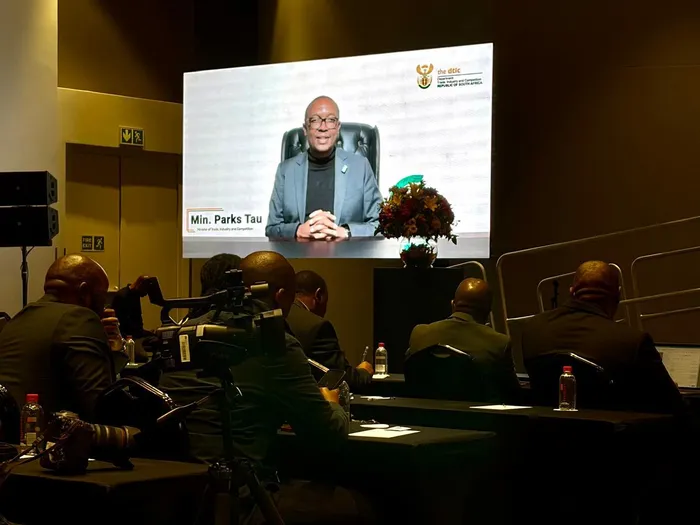
The Minister of Trade, Industry and Competition, Parks Tau, virtually addressing the inaugural National Policy Dialogue on Innovation and Industrialisation in Johannesburg on Friday.
Image: Supplied
Minister of Trade, Industry and Competition, Parks Tau, has called for stronger partnerships between government, industry, academia and labour to help South Africa convert innovation into industrial capacity, economic growth and job creation.
Speaking at the inaugural National Policy Dialogue on Innovation and Industrialisation on Friday, Tau said South Africa faces a critical moment as technological advancements, geopolitical shifts and the global transition to greener economies reshape industries and patterns of growth around the world.
The dialogue was hosted by the National Advisory Council on Innovation (NACI) in partnership with the Department of Science, Technology and Innovation, the Department of Trade, Industry and Competition and the OR Tambo Special Economic Zone.
“We gather at a pivotal moment for South Africa and the global economy. Around the world, technological change, shifting geopolitical dynamics, climate imperatives and digital transformation are reshaping industries, value chains and patterns of economic growth,” Tau said.
“The question before us is clear: how do we position South Africa to compete, grow and create opportunities in this rapidly changing environment?”
According to Tau, the answer lies in innovation-led industrialisation, which he described as a key driver of economic transformation.
“The answer lies in innovation-led industrialisation. Innovation and industrialisation are mutually reinforcing. Innovation drives productivity, competitiveness and technological advancement. Industrialisation creates jobs, expands productive capacity and unlocks new opportunities for economic participation,” he said.
“Together, they provide a pathway to inclusive growth and sustainable development.”
Tau acknowledged that South Africa continues to face significant economic challenges, including declining industrial capacity, persistently high unemployment and a disconnect between scientific research and commercial industrial application.
He said these challenges are not unique to South Africa, noting that many developing economies are grappling with technological dependence, energy insecurity and intensifying global competition.
Despite these obstacles, Tau argued that the country possesses substantial strengths that can be leveraged to drive industrial development and innovation.
He pointed to South Africa’s world-class research institutions, established industrial base, abundant critical mineral resources and entrepreneurial talent as foundations for future growth.
“Within these challenges lie significant opportunities. We have world-class research institutions, a strong industrial foundation, abundant critical mineral resources and immense entrepreneurial potential,” he said.
“The task before us is to harness these strengths to build a more competitive, resilient and inclusive economy.”
Tau described the policy dialogue as more than a discussion forum, calling it a platform for action aimed at reshaping the country’s industrial future.
He outlined several priorities, including stronger alignment between innovation and industrial policy, increased investment in advanced manufacturing, digital industries, green technologies and critical minerals beneficiation.
Tau also called for greater support for Special Economic Zones, small businesses and start-ups, which he said are critical drivers of innovation, localisation and employment creation.
In addition, he emphasised the need to accelerate digital transformation and develop the skills required to support future industries.
“A call to accelerate digital transformation and develop the skills required for the industries of the future,” Tau said.
He further stressed the importance of creating industrial ecosystems that are inclusive and geographically diverse, ensuring that economic opportunities are spread across the country rather than concentrated in a few areas.
Most importantly, Tau highlighted the need for partnerships across sectors to achieve meaningful economic transformation.
“No single institution can achieve this transformation alone,” he said. “Government, industry, academia and labour must work together to translate innovation into industrial capacity, and industrial capacity into jobs, investment and economic growth.”
Tau also urged participants to use the dialogue as a starting point for renewed collaboration and bold thinking.
“Let this dialogue mark the beginning of a renewed commitment to building a South Africa that is innovative, industrialised, globally competitive and inclusive,” he said. “Together, we can position South Africa not merely to adapt to global change, but to help shape it.”
BUSINESS REPORT