

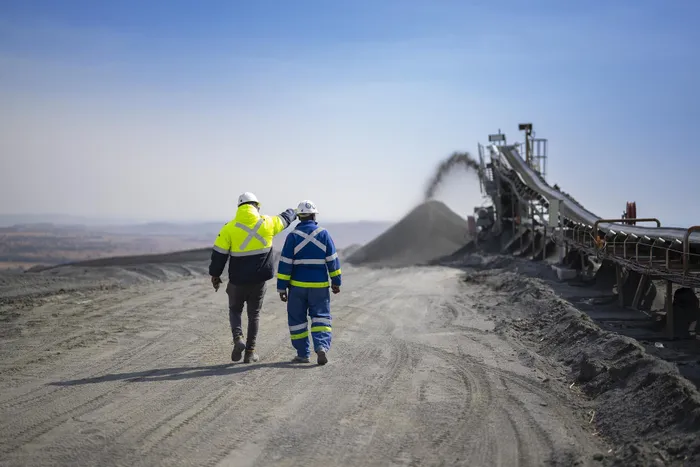
Cullinan Mine is Petra’s flagship asset and a world-class kimberlite, famous for being home of the largest gem diamond (3,106cts) ever recovered as well as being the world’s most important source of blue diamonds.
Image: Supplied
The National Union of Mineworkers (NUM) has strongly condemned Petra Diamonds' decision to place its Finch Diamond Mine in Kimberley under business rescue and issue a Section 189A retrenchment notice at its Cullinan Diamond Mine.
The union on Sunday warned that nearly 1,800 jobs and the livelihoods of thousands of families are under threat as a result of these actions.
In a statement, the union said the business rescue process at Finch has left about 689 workers facing uncertainty, while the retrenchment consultation process at Cullinan could affect approximately 1,090 employees.
Together, the developments place close to 1,800 jobs at risk and threaten the economic stability of mining communities that rely on the operations.
The union rejected what it described as efforts to shift the burden of business challenges onto workers, arguing that employees have contributed significantly to the company's sustainability and profitability over many years.
NUM chief negotiator and national health and safety secretary, Masibulele Naki, said workers should not be viewed as expendable whenever companies encounter financial difficulties.
"It is unacceptable for companies to continuously point fingers at labour costs whenever they face operational or financial challenges. Workers are not a liability on a balance sheet; they are the creators of value and wealth in the mining industry. Without workers, there is no production, and there is no profit," said Naki.
The union also expressed concern about what it sees as a growing trend within the mining industry where retrenchments and business rescue proceedings are increasingly being used as a first response to financial pressures rather than a measure of last resort.
Naki argued that labour costs should not be singled out as the primary cause of financial distress in mining companies.
"The narrative that labour is the highest cost to the company must be challenged. Executive remuneration, management decisions, declining investment strategies, market fluctuations, and operational inefficiencies also contribute significantly to the financial position of mining companies," he said.
"Workers should not be expected to pay the price for challenges they did not create."
Petra Diamonds has been taking proactive measures to adapt to a challenging landscape marked by weakness in rough diamond markets. Last year, the company postponed auctions and ramped up production in response to market conditions while also focusing on diversifying its product offerings.
While acknowledging that the global diamond industry is facing significant headwinds, including weak consumer demand, falling rough diamond prices, increased competition from laboratory-grown diamonds and broader economic uncertainty, the NUM said these factors must be honestly recognised when assessing the future sustainability of mining operations.
NUM further noted that exchange-rate volatility and fluctuations between the South African rand and the US dollar continue to affect mining revenues and production costs, factors that are beyond the control of workers.
The union argued that any evaluation of the future of Finch and Cullinan should consider these broader market realities, operational efficiencies and capital allocation decisions before jobs are sacrificed.
"Retrenchments cannot become a business strategy. Every job lost means a family pushed closer to poverty, a child whose future becomes uncertain, and a community that suffers economic decline. The social cost of retrenchments far outweighs any short-term financial benefit claimed by employers," Naki said.
The union has called for urgent intervention from government, arguing that the mining sector remains a strategic pillar of South Africa's economy and should not be left entirely to market forces.
It urged the Minister of Mineral and Petroleum Resources, the chief inspector of Mines, the Minister of Electricity and Energy, the Minister of Trade, Industry and Competition, and National Treasury to convene a multi-stakeholder intervention aimed at protecting jobs and sustaining investment.
"Government cannot be a spectator while nearly 1,800 workers and their families face an uncertain future. The mining industry remains one of the pillars of our economy, and every effort must be made to preserve jobs, sustain production, and protect communities that depend on mining for their livelihoods," Naki said.
NUM said it would actively participate in both the business rescue process at Finch and the Section 189A consultations at Cullinan, while demanding strict regulatory oversight to ensure compliance with labour, health and safety, and mining legislation.
BUSINESS REPORT