

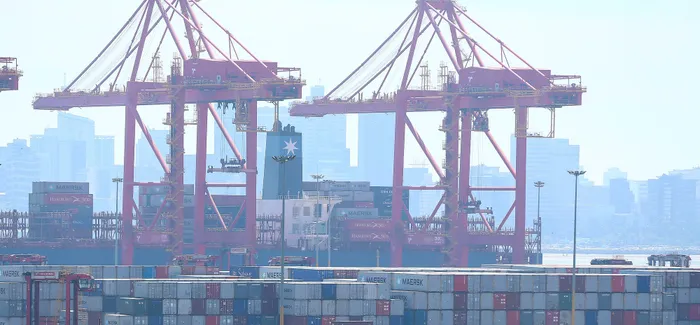
SAAFF said South Africa’s improving port performance remains encouraging but stressed that greater collaboration and data-sharing between Transnet, industry stakeholders and government are essential.
Image: Leon Lestrade/ Independent Newspapers
South Africa’s logistics network demonstrated resilience over the past week despite weather-related disruptions at major ports, rail challenges and ongoing instability in global shipping markets.
According to the latest logistics update compiled by the South African Association of Freight Forwarders (SAAFF), container terminals handled an average of 8,281 twenty-foot equivalent units (TEUs) per day, up from 8,060 TEUs the previous week.
Port operations delivered mixed results as adverse weather affected terminals in both the Eastern and Western Cape.
However, Durban and Cape Town’s Multi-Purpose Terminals recorded notable improvements in waterside operations, while Durban Container Terminal’s Pier 2 and Pier 1 also posted gains. Equipment availability remained strong across most facilities, helping maintain operational stability despite challenging conditions.
On the rail network, fuel shortages disrupted operations on the Botswana line during the week, although the issue was resolved by Friday.
Globally, shipping conditions remain volatile as tensions surrounding the Strait of Hormuz and the conflict involving Iran continue to create uncertainty for shipping routes and energy markets.
These risks have contributed to rising freight costs, with Drewry’s World Container Index surging 23% to $3,433 per forty-foot equivalent unit (FEU).
The report noted that higher freight rates have been driven by a combination of early peak-season demand, continued vessel diversions away from the Red Sea, tariff-related front-loading of shipments and rising bunker fuel costs.
International air cargo volumes through OR Tambo International Airport remained relatively stable, although slightly lower than the previous week. Average daily inbound cargo volumes declined 3% week-on-week to approximately 547,000 kilograms, while outbound volumes increased 4% to around 370,000 kilograms.
Despite the weekly fluctuations, cargo volumes remain slightly above both June 2025 levels and pre-pandemic June 2019 volumes.
On the N4 corridor linking South Africa and Mozambique, truck traffic eased slightly, with heavy goods vehicle volumes declining 6% to 1,517 trucks per day. Border queue times remained relatively stable at an average of 3.8 hours.
Across the Southern African Development Community (SADC) region, however, border crossing challenges persist. Median crossing times at South African borders increased to nearly 10 hours, while several regional crossings, including Chirundu, Kasumbalesa and Katima Mulilo, continued to experience severe delays exceeding 24 hours.
SAAFF said South Africa’s improving port performance remains encouraging but stressed that greater collaboration and data-sharing between Transnet, industry stakeholders and government are essential to improve efficiency, transparency and long-term competitiveness across the country’s logistics corridors.
BUSINESS REPORT