

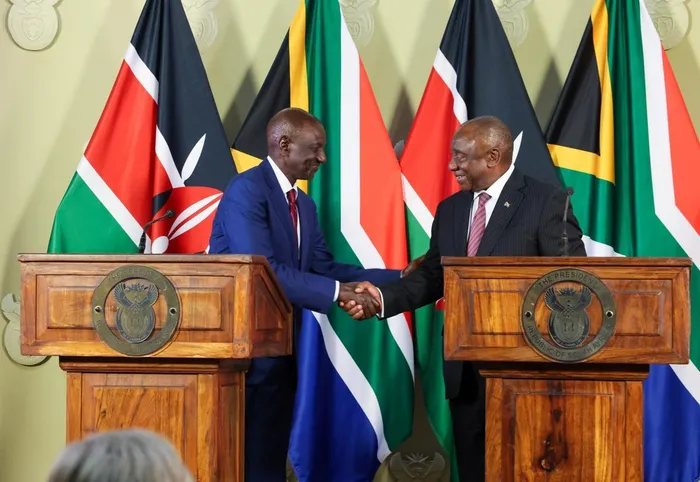
Kenyan President William Ruto with President Cyril Ramaphosa during the State Visit to South Africa at the Union Buildings in Pretoria on Thursday.
Image: GCIS
South Africa and Kenya have pledged to accelerate trade, investment and economic cooperation as the continent's two leading economies seek to leverage the African Continental Free Trade Area (AfCFTA) to drive growth, industrialisation and job creation.
The commitment was reaffirmed on Thursday during Kenyan President William Ruto's State Visit to South Africa, where he and President Cyril Ramaphosa outlined an ambitious agenda aimed at deepening economic integration between East and Southern Africa.
Speaking at the Union Buildings following bilateral talks, Ramaphosa described Kenya as one of South Africa's most important strategic partners on the continent and highlighted the growing importance of economic cooperation between the two countries.
"Our economic partnership is one of the most strategic pillars of our bilateral cooperation," Ramaphosa said.
He noted that Kenya remains South Africa's largest trading partner in East Africa and a key destination for South African investment, with local companies active in sectors ranging from financial services and retail to information technology, manufacturing, infrastructure and pharmaceuticals.
South Africa's development finance institutions and private sector investors are also increasing their presence in Kenya, with early 100 foreign direct investment projects worth more than R33 billion and around 7,600 jobs created.
South Africa's investment footprint spans sectors such as ICT, communications, business services, real estate and financial services.
Ramaphosa said the AfCFTA presents a significant opportunity to unlock greater trade flows and industrial development across the continent.
"President Ruto and I agreed that the AfCFTA must serve as a catalyst for inclusive growth, industrialisation and job creation," he said. "It should facilitate the development of regional value chains, support African manufacturing and create greater opportunities for young people, women and entrepreneurs across our continent."
The two leaders also emphasised the importance of reducing barriers to trade and improving market access between African economies.
Ruto revealed that bilateral trade between Kenya and South Africa grew to $650 million (around R10.5 billion) in 2025 from $590m in 2024, representing an increase of $60m or more than 10% in a single year.
While welcoming the growth, he said both governments were determined to accelerate the pace of economic integration.
"This momentum must not only be sustained, but it must also accelerate," Ruto said. "We acknowledge that real obstacles still remain, including tariff and non-tariff barriers, limited market access and regulatory constraints."
To address these challenges, Ramaphosa and Ruto directed their respective trade ministers to implement recommendations from the South Africa-Kenya Joint Trade Committee and remove obstacles that continue to hinder commerce between the two economies.
Ruto said greater utilisation of both the AfCFTA and the Tripartite Free Trade Area would help expand market access, lower business costs and unlock the full potential of intra-African trade.
The strengthening of economic ties comes at a time when global trade patterns are being reshaped by geopolitical tensions, supply chain disruptions and growing protectionism.
Ruto said African countries must respond by deepening cooperation and taking greater ownership of their economic future.
"We met at a moment when the world order is shifting, when what was once certain is now in doubt and when Africa's role in shaping global outcomes has never been more consequential," he said.
Ruto also praised South Africa's leadership of the G20, saying it had helped place African development priorities, global financial reform and the interests of the Global South at the centre of international discussions.
Beyond trade and investment, the two countries signed six agreements covering trade facilitation, standards and regulation, shipping and maritime cooperation, technical and vocational education, sports, arts and culture, and women's empowerment.
Business mobility and tourism were also highlighted as important drivers of economic growth.
Ruto welcomed the visa-free regime introduced between the two countries in 2023, saying it had boosted tourism, trade and cultural exchanges.
According to figures shared during the visit, arrivals from Kenya to South Africa increased by 18.7% following the introduction of the 90-day visa-free entry policy, while more than 58,000 Kenyan visitors travelled to South Africa in 2025 alone.
For both governments, the deeper partnership is about more than bilateral trade. It is also seen as a model for broader continental integration under the African Union's Agenda 2063.
BUSINESS REPORT