

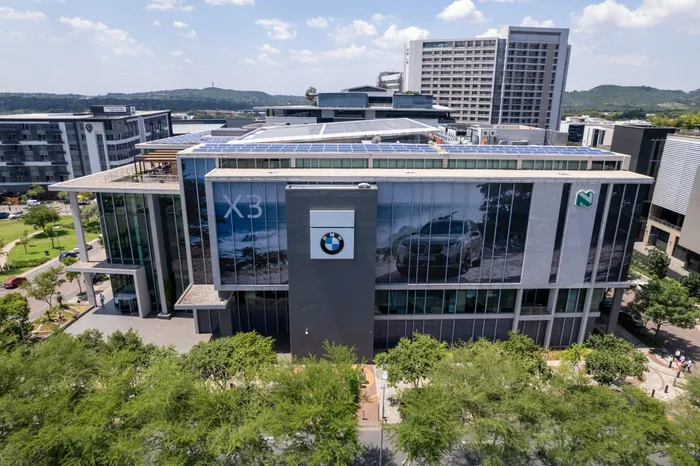
The German luxury vehicle manufacturer on Wednesday celebrated 20 years of the BMW IT Hub in Pretoria, a milestone that underscores the growing importance of South Africa within the company's global operations.
Image: Supplied
BMW Group says its global diversification, broad technology portfolio and growing innovation capabilities in South Africa are helping the luxury vehicle manufacturer navigate an increasingly volatile global automotive market.
This comes as the German luxury vehicle manufacturer on Wednesday celebrated 20 years of the BMW IT Hub in Pretoria, a milestone that underscores the growing importance of South Africa within the company's global operations.
As global automotive manufacturers grapple with trade tensions, economic uncertainty and rapid technological disruption, BMW is increasingly looking to South Africa as a source of innovation, digital expertise and business transformation.
In an interview with Business Report during a visit to South Africa, BMW AG board member responsible for customer, brand and sales, Jochen Goller, acknowledged that geopolitical tensions, trade disputes and uneven economic growth are creating significant uncertainty across global markets.
“There is a lot of volatility in the market. You have tariffs, different economic parameters in many countries and now, of course, the Middle East crisis,” Goller said. “But for us, I would say we're still in a stronger position than most of the competitors.”
The German automaker is experiencing sharply contrasting conditions across its key markets.
Goller said that Europe, BMW’s largest market, continues to perform strongly, supported by growing demand for electric vehicles. He said sales remain stable in the United States and are outperforming the broader market, while South Africa has returned to growth after a slow start to the year.
China, however, he said remains the company’s biggest challenge.
“The total market in China is around 20% down and that is dragging everyone down,” Goller said.
Despite these pressures, BMW expects to maintain sales broadly in line with previous levels, supported by its diversified global footprint and strategy of offering multiple powertrain technologies.
Unlike some competitors that have focused heavily on electrification, BMW continues to offer fully electric vehicles, plug-in hybrids, diesel models and traditional combustion-engine vehicles.
“If the market shifts into one technology, we are prepared. Europe is seeing electric vehicle growth, while in the US electric vehicle sales are declining. We have solutions for both markets,” Goller said.
While South Africa contributes a relatively small share of BMW’s annual global sales of approximately 2.5 million vehicles, Goller described the country as “punching well above its weight” within the BMW Group.
He said innovations developed locally are increasingly being adopted internationally, particularly BMW South Africa’s direct sales model, which has transformed how customers purchase vehicles.
The model allows customers to browse inventory online, configure vehicles, explore financing options and purchase at a fixed national price, eliminating traditional price negotiations between dealers and buyers.
BMW Group South Africa CEO Peter van Binsbergen said the system offers customers greater transparency and certainty.
“Customers get exactly the car they want and they know they are paying the best market price. They no longer have to wonder whether somebody else negotiated a better deal,” he said.
According to Van Binsbergen, the approach has improved customer satisfaction while simultaneously increasing retailer profitability. The strategy has also strengthened vehicle residual values by reducing excessive discounting and creating more consistent pricing across the market.
“With our guaranteed future value products, more than 97% of customers keep their vehicles at the end of the contract because the cars are worth more than we originally guaranteed,” he said.
Van Binsbergen said BMW South Africa’s direct sales model has generated a rich pool of customer data that provides valuable insights into buying behaviour.
“We can see which vehicle configurations sell the quickest, which command the highest prices and which ones do not move. That allows us to make much better decisions and avoid ageing stock,” he said.
Goller added that South Africa’s success has attracted attention across the BMW Group, with the locally developed direct sales software now being exported to other international markets.
Beyond vehicle sales, South Africa is becoming increasingly important to BMW’s digital transformation ambitions.
Artificial intelligence is being deployed across virtually every aspect of the company’s operations, from supplier management and manufacturing quality control to logistics and customer analytics.
Goller said AI-powered systems are already being used to inspect components supplied to factories, identify paint defects on completed vehicles and monitor battery cell production to detect imperfections before assembly.
“It’s across the whole supply chain, production and logistics process,” he said.
The technology is also helping BMW better understand customer preferences and predict demand patterns, enabling more accurate vehicle specifications and inventory planning.
BUSINESS REPORT