

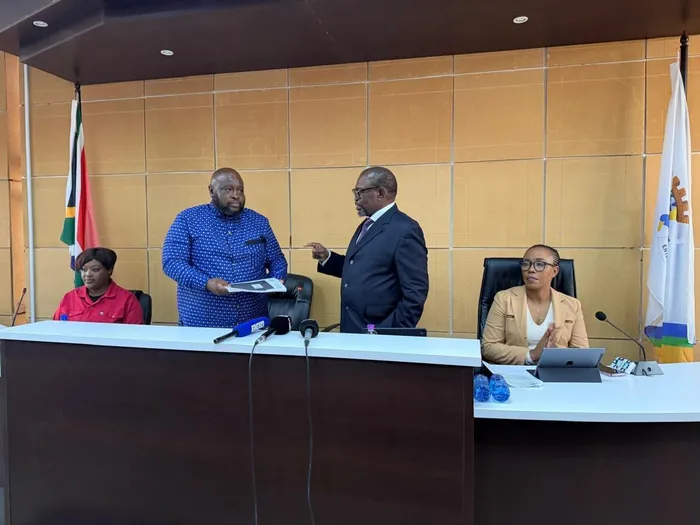
Finance Minister Enoch Godongwana officially handed over the Financial Recovery Plan (FRP) to Ditsobotla Local Municipality Mayor, Molefe Morutse on Friday.
Image: Supplied
Finance Minister Enoch Godongwana has called for a fundamental change in mindset and governance at Ditsobotla Local Municipality in the North West province as the government intensifies efforts to rescue the struggling municipality from years of financial collapse and deteriorating service delivery.
Godongwana concluded a visit to the North West municipality on Friday, where he officially handed over a revised Financial Recovery Plan (FRP) and outlined the responsibilities of municipal leaders and administrators in implementing the turnaround strategy.
The intervention follows Cabinet’s decision in September 2025 to invoke Section 139(7) of the Constitution, placing the municipality under mandatory national intervention after repeated failures to restore stability.
According to National Treasury, Ditsobotla has already undergone eight unsuccessful interventions. Headquartered in the town of Lichtenburg, the municipality includes surrounding areas like Coligny and features local landmarks like the Molemane Eye Nature Reserve.
For a municipality that has endured nearly a decade of failed interventions, the government hopes the latest recovery plan will finally provide a roadmap to restoring financial stability, rebuilding public confidence and improving essential services for residents.
“I can only surmise that part of the reason for eight failures is that we have not fully embraced what it means to be under an intervention,” Godongwana said.
“When a municipality is under intervention, it is not operating under normal conditions. Habits, attitudes and mindsets must shift in this process. An intervention mindset must be adopted to kickstart recovery.”
The revised recovery plan paints a bleak picture of the municipality’s finances. Ditsobotla has no cash available to cover operational expenditure, with its cost coverage ratio sitting at negative one month, far below the accepted norm of one to three months. The municipality’s current liabilities also significantly exceed its current assets.
The report further reveals alarming levels of infrastructure losses, with electricity distribution losses soaring to 85% in the 2024/25 financial year, while water losses reached 58%. Both figures are far above acceptable industry norms and have contributed significantly to the municipality’s financial distress.
One of the most concerning findings is the municipality’s inability to pay creditors. Ditsobotla now takes an average of 3,188 days—more than eight years—to settle accounts with suppliers, compared with a target of 30 days.
The municipality’s debt collection performance is equally troubling. Revenue collection rates stand at only 44%, while outstanding consumer debt has ballooned to R1.3 billion. The report notes that weak credit control measures, poor billing systems and resistance to debt collection have undermined revenue recovery efforts.
The recovery plan also highlights serious operational deficiencies. Only 448 of Ditsobotla’s 18,101 registered water meters are currently being read and billed, while just 273 of 1,261 electricity meters are actively monitored. The municipality estimates that only about 10% of residential properties have functioning electricity meters.
To address these challenges, National Treasury plans to assist the municipality with smart metering and bulk supply metering projects. The recovery plan aims to improve billing accuracy, reduce illegal connections and substantially increase revenue collection.
Godongwana stressed that the intervention would not come with a financial bailout.
“Neither national nor provincial interventions are accompanied by financial bailouts. However, this does not mean that other forms of support will not be provided to get you moving,” he said.
“The National Treasury will provide you with fuel by exploring options to assist the municipality with smart metering and metering for bulk supply and will investigate further opportunities for assistance.”
A key component of the turnaround strategy is a new Distribution Agency Agreement with Eskom. Ditsobotla has completed the Section 78 process required for the agreement, which will allow Eskom to assume responsibility for electricity revenue collection and technical management within the municipality.
The Financial Recovery Plan also identifies severe service delivery challenges, including inadequate water supply, deteriorating roads, non-functional landfill sites, weak infrastructure maintenance and widespread vandalism of municipal assets.
The municipality is currently experiencing water rationing and cannot accurately measure many of its water losses because of damaged or absent metering infrastructure.
National Treasury said it would closely monitor implementation through monthly progress reports and quarterly “War Room” meetings. In addition, Godongwana will submit quarterly reports to Cabinet in terms of Section 147 of the Municipal Finance Management Act.
BUSINESS REPORT