

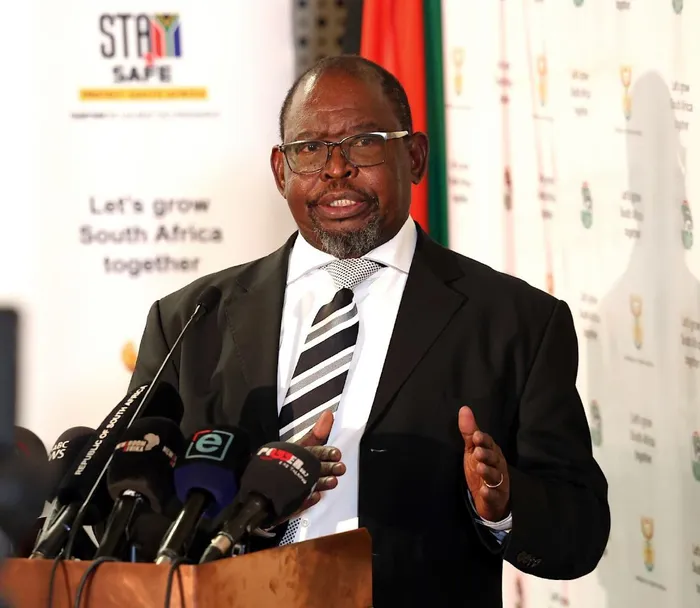
Finance Minister Enoch Godongwana. The National Treasury welcomed the decision by Moody's, describing it as evidence that government’s fiscal consolidation strategy is beginning to deliver tangible results.
Image: Supplied
Ratings agency Moody's has upgraded South Africa’s sovereign credit outlook to positive from stable, citing improving fiscal discipline, structural reforms and stronger investor confidence, in a move welcomed by government as a major vote of confidence in the country’s economic direction.
In a ratings action released on Friday, Moody’s affirmed South Africa’s long-term foreign and local currency ratings at Ba2 but revised the outlook upward, signalling the possibility of a future ratings upgrade if reforms and fiscal improvements continue.
The positive outlook marks Moody’s first upward outlook revision for South Africa since 2007. Treasury noted that the development follows a one-notch sovereign ratings upgrade by S&P Global in November 2025, which also retained a positive outlook on the country.
The agency said South Africa’s fiscal position was gradually strengthening, supported by rising primary budget surpluses, moderating debt-service costs and sustained reform efforts aimed at improving energy, logistics and infrastructure performance. It expects real GDP growth to rise gradually to around 2% by 2028, underpinned by higher investment and reform momentum.
The ratings agency said South Africa’s primary budget surplus in the 2025 fiscal year exceeded expectations at around 1% of GDP, driven by strong revenue growth and expenditure restraint. It projected the primary surplus could rise to about 2% by 2028, helping stabilise government debt and gradually reduce the debt-to-GDP ratio to around 85% from an estimated 87% in 2025.
Moody’s also highlighted the improving performance of State-owned enterprises, lower borrowing costs and investor optimism linked to reform implementation and South Africa’s removal from the Financial Action Task Force grey list.
However, the agency warned that significant risks remain. It said South Africa’s growth potential was still constrained by a weak labour market, infrastructure bottlenecks, inequality and high debt-servicing costs. Headline interest expenditure remains elevated at about 19% of government revenue.
Moody’s further cautioned that the ongoing Middle East conflict could weigh on inflation, household incomes and economic growth, although it believes macroeconomic stability will be maintained and fiscal discipline preserved.
The agency also said its baseline assumption is that the Government of National Unity is expected to remain intact through its term, providing continuity for reforms ahead of the 2029 general election. While reform momentum could slow during the electoral cycle, Moody’s said the risk of abrupt policy reversals appeared limited.
The National Treasury welcomed the decision, describing it as evidence that government’s fiscal consolidation strategy is beginning to deliver tangible results.
“Government welcomes Moody’s decision to revise South Africa’s sovereign credit rating outlook to positive from stable and affirm the domestic and foreign-currency long-term ratings at ‘Ba2’,” Treasury said in a statement.
Treasury noted that South Africa is currently the only G20 country with a positive outlook from Moody’s, at a time when global sovereign ratings are under pressure due to geopolitical instability and the economic fallout from the ongoing Middle East conflict.
Duncan Pieterse, director-general of the National Treasury, said the decision reflected improving confidence in South Africa’s public finances.
“The latest decision by Moody’s is further confirmation of South Africa’s improving fiscal credibility due to a turnaround in the sustainability of public finances,” Pieterse said.
He added that government remained focused on maintaining revenue above non-interest spending and ensuring the debt-to-GDP ratio declines over time.
“We plan to embed the fiscal turnaround with the introduction of a fiscal anchor for South Africa,” Pieterse said.
BUSINESS REPORT