

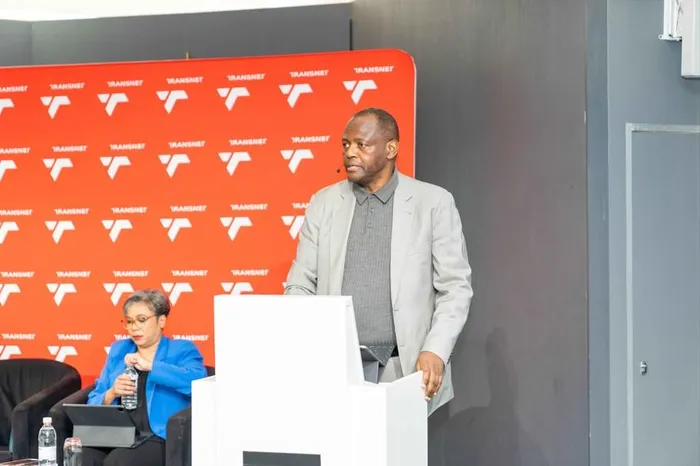
Transnet board chairperson Dr Andile Sangqu together with Transnet Group CEO Michelle Phillips, taken during the announcement of Transnet's Annual Financial Results for the period ending on 31 March 2025.
Image: Supplied
By Nqobani Mzizi
I have long believed that those who have travelled a path are best placed to guide others on it. It was at a recent masterclass at GIBS Business School where Dr Andile Sangqu, the chairperson of Transnet, reflected on the organisation’s turnaround journey. The discussion extended beyond the scale of the challenge and pointed to something deeper about governance when institutions come under severe strain.
He described the organisation he inherited in 2023 as one in distress, where fundamental performance signals had deteriorated. The image he used was striking. Describing himself as a very visual leader, he likened the situation to an aircraft in rapid descent, requiring decisive intervention to avoid collapse.
Turnarounds of this nature bring governance into sharp focus. They expose the limits of passive oversight and require a level of intentionality that goes beyond routine board processes. It is in these moments that the role of the board, and particularly that of the chairperson, becomes most consequential.
The first task of any board confronting a distressed organisation is diagnosis. It is tempting to rely on reports, dashboards and formal submissions. These remain important and are often shaped by structure and interpretation. A deeper understanding requires engagement with the organisation itself.
In this case, the approach extended beyond the boardroom. There was deliberate engagement with employees across the country through town hall sessions, open dialogue and accessibility. This governance decision reflects an understanding that insight resides within the institution: in its people, operations and daily realities, alongside formal reporting lines. Boards that govern effectively in times of distress recognise that strategy begins with understanding. Without that foundation, responses risk being well-structured yet misdirected.
With diagnosis complete, the board's focus must shift to strategy. Turnaround strategies cannot be treated as abstract plans. They require clarity, structure and discipline. The strategy reflected a high level of granularity. It was structured across defined time horizons, with clear performance expectations and close monitoring. Execution was deliberate, supported by regular assessment and responsiveness to deviation.
This reflects an important governance principle. Strategy extends beyond board approval and requires ongoing shaping, monitoring and refinement. The distinction lies in whether the board approaches strategy as a periodic obligation or a continuous responsibility.
In periods of recovery, this responsibility intensifies. Oversight becomes closer, more frequent and more deliberate. This creates a natural tension. How does a board remain sufficiently engaged without becoming operational?
The answer lies in clarity of role and intent. Effective boards understand the difference between proximity and interference. They remain close to the organisation’s performance, its risks and its trajectory, while preserving the boundary that ensures management retains responsibility for execution.
Strong oversight requires the board to insist on accountability, clarity and performance. This balance is especially important in organisations emerging from crisis. The instinct to intervene directly can be strong, yet the discipline of restraint is required alongside decisive action.
A further dimension of the turnaround involved the rebuilding of relationships. Over time, the organisation had experienced a breakdown in trust with its clients. Re-establishing these relationships became a strategic priority. There was a deliberate effort to engage stakeholders, communicate openly about challenges and maintain transparency regarding capacity and performance.
Trust is a critical governance outcome. Maintaining it enables organisations to secure support even in periods of difficulty. The chairperson emphasised that stakeholder goodwill moved beyond tolerance, translating into active support, with some clients offering assistance to help the organisation recover. This illustrates a broader point: governance extends beyond internal processes to encompass the organisation’s relationships with its stakeholders and the confidence it inspires.
Culture also emerged as a central theme. Values centred on openness, transparency and honesty were clearly articulated. They were positioned as behavioural expectations to be demonstrated consistently from the top, with the board playing a defining role. Culture is shaped by what leadership tolerates, reinforces and models. When values are lived visibly, they begin to influence behaviour across the organisation, shaping over time the environment in which decisions are made and actions are taken.
Boards influence organisational outcomes through the individuals they select to lead, making leadership appointments a critical lever. In a turnaround context, this becomes even more significant. Executives must possess technical capability, judgement, resilience and alignment to operate in a demanding environment.
Alignment between the board and management is equally important. In this case, the relationship required resetting. Management had become accustomed to escalating problems without accompanying solutions, with decision-making not always occurring at the appropriate level. Re-establishing expectations required clarity: management must manage, and the board must oversee, challenge and support. Without this clarity, accountability becomes diffused, requiring decisive action from the board.
Turnarounds are often associated with financial recovery. Financial performance remains important and is usually the result of deeper structural and governance changes. Strengthening controls, improving oversight and enforcing accountability create the conditions within which performance can improve. The adoption of a zero-tolerance approach to misconduct signalled that governance was being restored as a priority.
The human dimension was critical, with the board prioritising recognition of performance as part of the recovery effort, even in the absence of profitability. This reflects an understanding that organisations are sustained by people. Motivation, morale and belief influence execution in ways that formal structures cannot fully capture.
The role of the chairperson in this process is significant. They shape how the organisation is governed through visibility, accessibility and clarity of purpose, setting the tone at the top. In times of distress, this tone becomes particularly important, influencing how the organisation responds, how decisions are approached and how accountability is experienced.
The journey described reflects progress rather than completion. The organisation has moved beyond crisis, yet continues to navigate complexity. This is often the reality of large-scale turnarounds. They do not conclude at a single point in time. They evolve as conditions change and new challenges emerge.
For boards, the lesson is clear. Turnarounds require more than oversight in the traditional sense. They demand intentional governance across diagnosis, strategy, culture, leadership and accountability. They require boards to engage deeply, act decisively and maintain discipline throughout the process.
If the lessons shared by Dr Andile Sangqu offer any indication, boards overseeing turnarounds should regularly ask themselves:
Turnarounds reveal governance in its most demanding form. They test whether structures, roles and responsibilities are being applied with intent. In the end, recovery is shaped not only by what is done, but by how it is governed.
If Transnet and Eskom sustain their current trajectory, one conclusion is inescapable: intentional governance, particularly in the public sector, has never been more critical.

Nqobani Mzizi is a Professional Accountant (SA), Cert.Dir (IoDSA) and an Academic.
Image: Supplied
* Nqobani Mzizi is a Professional Accountant (SA), Cert.Dir (IoDSA) and an Academic.
** The views expressed do not necessarily reflect the views of IOL or Independent Media.
BUSINESS REPORT