

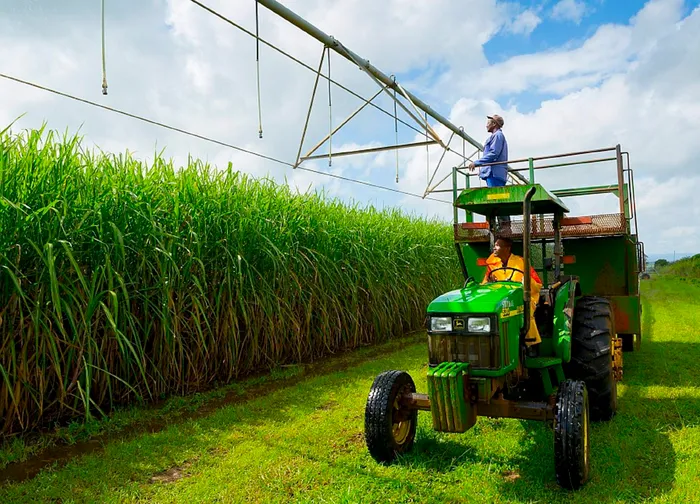
The industry’s distress is compounded by a trade policy framework that has simply not kept pace with commercial reality.
Image: Simphiwe Mbokazi/Independent Newspapers
By Higgins Mdluli
Nobody expected farming to be easy. But the men and women who cultivate sugarcane across the rolling hills of KwaZulu-Natal and Mpumalanga are now facing a convergence of pressures so severe that the very survival of South Africa’s sugar industry hangs in the balance. Policymakers in Pretoria would be wise to pay attention and to act before the moment passes.
The war in the Middle East has driven oil prices at times above $108 a barrel, sending the cost of both diesel and fertiliser sharply higher. Fertiliser, derived from oil-based by-products, accounts for roughly 20% to 22% of an average sugar farmer’s total input bill and can be expected to nearly double in price. Diesel, meanwhile, is forecast to rise by more than R10 a litre in April, a catastrophic increase that threatens survival of many in the agricultural industry.
Most sugarcane growers are small-scale operators who truck their harvested cane to the nearest mill for crushing. Transport costs already consume 14% of the input bill for the areas that don’t require irrigation and 11% those in the irrigated regions of Mpumalanga, while fuel & lubricants for various farm activities add a further 6% to 15% in costs. Combined, the rising cost of transport, irrigation and fertiliser is making sugar production more expensive than anyone could have predicted.
Then there is the looming catastrophe of Tongaat Hulett. The 136-year-old company’s potential liquidation is not merely just another story of corporate mismanagement, but one that threatens the foundations of the entire sugar industry.
Tongaat Hulett is South Africa’s only standalone refiner of white sugar, the grade essential to the country’s beverage and confectionery manufacturers, and it serves as the milling hub for roughly 18,000 of the country’s 28,000 registered cane growers across the two provinces. Should it collapse, the downstream consequences would be swift and irreversible: the bulk of local growers with nowhere to sell their sugarcane, and most, if not all, white sugar procurement would shift offshore in volume, undercutting local producers.
The social stakes are equally profound. Sugarcane farming is a critical stabilising force in some of South Africa’s most economically precarious rural communities, providing employment in Mpumalanga and on KwaZulu-Natal communal land, including the difficult-to-farm, small hilly tracts held under the Ingonyama Trust.
Researchers who have studied the region’s agricultural potential have concluded that no alternative crop can readily replace sugarcane at scale in these areas. Avocados and macadamias may offer long-term diversification for well-capitalised farmers, but they demand capital outlays and lead times that place them firmly beyond the reach of the small-scale grower who makes up the backbone of the industry.
The sugar industry has a unique model where small-scale and large-scale growers are part of the commercial value chain and share in the revenues of the industry.
The industry’s distress is compounded by a trade policy framework that has simply not kept pace with commercial reality. The world sugar price has been falling since 2024, remaining depressed through 2025 as heavily subsidised imports from India, Brazil and Thailand flood the local market.
In January 2026 alone, 24,600 tons of deep-sea sugar entered South Africa, more than the total imports recorded in the whole of 2022. For the full 2025/26 season, almost 200,000 tons of imported refined sugar entered the country, driven by a low global sugar price, a relatively stronger rand-dollar exchange rate and weak local tariff protections.
Early 2026 data suggests imports are still rising, and adjustments to the import tariff have had no discernible effect. The local industry loses more than R7,000 for every ton of locally produced sugar displaced by imports, a combined blow of R1.5 billion on the industry in a single season, at precisely the moment it can least afford it.
Import duties on sugar do exist, and the industry acknowledges the ongoing work by the relevant authorities to review and adjust these measures. However, the current tariff is sometimes implemented too many months after the world sugar price drops, leaving local producers exposed during critical periods when protection is most needed.
In addition, the dollar-based reference price that triggers tariff adjustments has remained unchanged since 2018. In an environment of increased production costs, heightened commodity volatility and currency fluctuations, there is an opportunity to modernise this benchmark and bring it in line with costs of producing sugar. Doing so would strengthen the effectiveness of existing trade protections, at relatively low cost to the fiscus, while providing meaningful and timely relief to thousands of growers.
The argument for government support is one of strategic interest. A sugar industry that endures keeps rural communities employed, sustains the tax base in two provinces and preserves food-sector sovereignty. The tools to protect it are at hand. The question is whether there is the will to use them before the damage becomes permanent.

Higgins Mdluli is the chairman of SA Canegrowers.
Image: Supplied
* Higgins Mdluli is the chair of SA Canegrowers.
** The views expressed do not necessarily reflect the views of IOL or Independent Media.
BUSINESS REPORT