

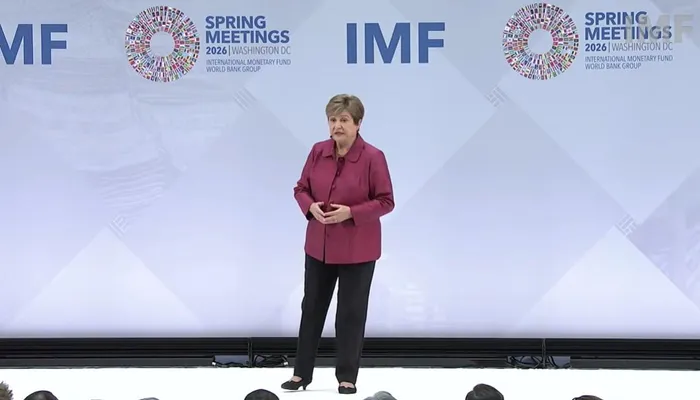
The International Monetary Fund (IMF) managing director, Kristalina Georgieva, giving a curtain-raiser speech on Thursday ahead of the upcoming IMF/World Bank Spring Meetings next week in Washington D.C.
Image: IMF YouTube screengrab
The global economy is facing a renewed test of resilience following the recent Middle East conflict, with higher energy prices, disrupted supply chains, and rising uncertainty expected to weigh on growth, according to the International Monetary Fund (IMF) managing director, Kristalina Georgieva.
In a curtain-raiser speech on Thursday ahead of the upcoming IMF/World Bank Spring Meetings, Georgieva cautioned that even under the most optimistic scenario, the world economy will experience a downgrade in growth prospects due to the far-reaching effects of the shock.
“A resilient world economy is being tested again,” she said, pointing to the now-paused war in the Middle East as a major disruption that has already inflicted “considerable hardship around the globe.”
At the core of the economic strain is a severe supply shock, with global oil flows cut by roughly 13% and liquefied natural gas (LNG) supplies down by about 20%. The immediate consequence has been a surge in energy prices, with Brent crude oil jumping from $72 per barrel before the conflict to a peak of $120.
Although prices have since eased, they remain significantly elevated, placing pressure on both households and businesses worldwide. Georgieva emphasized that the shock is global and uneven in its impact.
“All of us now [are] paying more for energy and with supply chains disrupted across the world,” she said, noting that the burden falls heaviest on oil-importing nations and countries with limited fiscal space.
She said vulnerable regions, including parts of sub-Saharan Africa and small island states, are particularly exposed. Georgieva said the consequences are already cascading through the global economy.
Fuel shortages—especially diesel and jet fuel—are disrupting transportation, trade, and tourism. Food insecurity is also worsening, with an additional 45 million people at risk due to higher transport and fertilizer costs, pushing global hunger levels above 360 million.
Beyond the immediate price shock, Georgieva warned of deeper economic risks. Rising input costs are feeding into broader inflation, while supply shortages are dampening demand. At the same time, inflation expectations in major economies such as the United States and Europe are shifting upward, raising concerns about the potential for a prolonged inflationary cycle.
She said financial conditions have also tightened. Emerging market borrowing costs have risen, equity markets have adjusted, and the US dollar has strengthened—factors that collectively increase pressure on developing economies.
Fuel shortages—especially diesel and jet fuel—are disrupting transportation, trade, and tourism. Food insecurity is also worsening, with an additional 45 million people at risk due to higher transport and fertilizer costs, pushing global hunger levels above 360 million.
Beyond the immediate price shock, Georgieva warned of deeper economic risks. Rising input costs are feeding into broader inflation, while supply shortages are dampening demand. At the same time, inflation expectations in major economies such as the United States and Europe are shifting upward, raising concerns about the potential for a prolonged inflationary cycle.
She said financial conditions have also tightened. Emerging market borrowing costs have risen, equity markets have adjusted, and the US dollar has strengthened—factors that collectively increase pressure on developing economies.
Despite these challenges, Georgieva highlighted that the global economy entered this period with strong underlying momentum, driven in part by investment in artificial intelligence and technology. “Had it not been for this shock, we would have been upgrading global growth,” she said.
However, the damage to critical energy infrastructure—such as Qatar’s Ras Laffan LNG complex—and ongoing disruptions to key shipping routes, including the Red Sea, suggest that recovery will be uneven and prolonged.
“Even in the best case, there will be no neat and clean return to the status quo ante,” she warned.
Looking ahead, the IMF will present a range of scenarios in its upcoming World Economic Outlook next week, reflecting uncertainty over how long elevated energy prices will persist and how deeply second-round effects will take hold.
Georgieva urged policymakers to act with caution and coordination. She warned against unilateral measures such as export bans and price controls, which could exacerbate global imbalances.
Instead, she called for targeted fiscal support for vulnerable populations and a steady commitment from central banks to maintain price stability.
“This being a classic negative supply shock, demand adjustment is unavoidable,” she said, adding that poorly coordinated policies could worsen the situation.
“It would be like driving with one foot on the accelerator and one on the brake—not good.”
She also stressed the importance of rebuilding fiscal space, noting that rising public debt and higher interest payments are limiting governments’ ability to respond to crises. Financial regulators, meanwhile, must remain vigilant to ensure stability in an environment of heightened risk.
The IMF expects demand for its financial support to increase by between $20 billion and $50bn in the near term, depending on how the situation evolves. Georgieva reassured member countries that the institution is well-equipped to respond.
Ultimately, she underscored that sound economic management remains the best defense against external shocks. “The strength and agility of your fundamentals is your best defense when shocks come—and come they will,” she said.
BUSINESS REPORT