

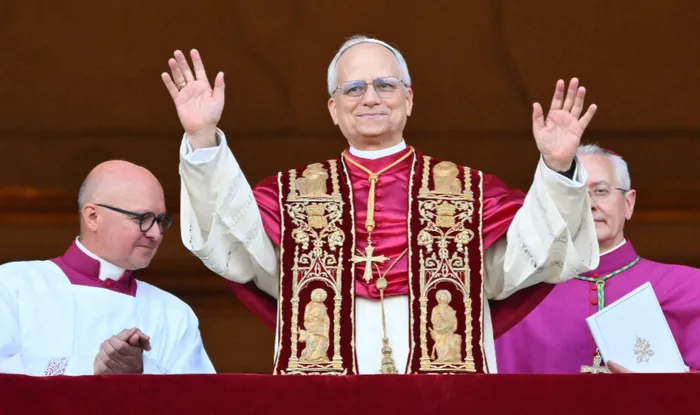
Pope Leo speaking during an Easter Vigil on Saturday. The Catholic Church offers one of the most enduring examples. Its structure has remained remarkably consistent over time, anchored in defined roles, layered authority and formalised processes of succession, says the writer.
Image: Alberto Pizzoli / AFP
By Nqobani Mzizi
As the Easter weekend drew to a close, I found myself reflecting on it from a perspective that extends beyond faith and tradition. It is a period that draws global attention for its spiritual significance and for the enduring institutions that carry it forward across generations. What struck me is how these institutions have sustained continuity for centuries through carefully structured systems of authority, accountability and succession.
It is difficult to ignore the parallels between these structures and those that define modern corporate governance. Many of the principles that underpin contemporary organisational design can be traced to earlier institutional forms.
The Catholic Church offers one of the most enduring examples. Its structure has remained remarkably consistent over time, anchored in defined roles, layered authority and formalised processes of succession. The Pope holds ultimate executive authority during a papacy, yet that authority exists within a broader system that includes the College of Cardinals. The conclave process is rigorous, deliberate and largely insulated from external influence. It reflects a system that recognises both the importance of leadership and the risks associated with concentrated authority.
The lesson extends beyond the Church. Leadership in any context requires both authority and constraint. Authority enables direction, while constraint ensures that such direction remains aligned with the broader purpose and integrity of the organisation. Where one exists without the other, imbalance follows.
Succession sits at the centre of this balance.
In the Catholic Church, succession is neither incidental nor reactive. It is embedded in the structure of the institution. The pool from which a Pope is selected is not arbitrary. It is drawn from individuals who have operated within the system, who understand its workings and who have been shaped by its disciplines. The process through which selection occurs is deliberate, even if not fully visible. It carries a sense of continuity, while also allowing for renewal.
Modern corporate organisations operate within a different context, yet the underlying principles remain relevant. Succession in corporate settings is often one of the most significant responsibilities of the board of directors. It requires foresight, judgement and discipline. It demands that boards look beyond immediate performance and consider the long-term sustainability of leadership. It also requires an understanding of the organisation itself, its culture, its strategic direction and the capabilities required to lead it forward.
Recent developments in South Africa provide practical illustrations of this. At the South African Revenue Service, the transition from Commissioner Edward Kieswetter to Dr Nqobani Johnstone Makhubu reflects a process drawn from within the institution. The incoming Commissioner has been part of the leadership structure, with direct exposure to operations and stakeholder engagement. The appointment process, led by the Presidency, has drawn scrutiny and public interest. While the contexts differ, there is a clear emphasis on continuity, institutional knowledge and structured selection.
A similar principle can be observed in the corporate sector. At Old Mutual, the transition of board chairperson position from Trevor Manuel to Roger Jardine has been managed through a defined succession process. The appointment of a chairman-designate, followed by a structured handover period leading up to the annual general meeting, reflects a deliberate approach to leadership transition. It signals the importance of continuity, preparation and clarity in governance.
These examples illustrate what well-considered succession can look like. They also point to the risks that arise when succession is not given the same level of attention. In environments where leadership becomes closely associated with a single individual, succession can become uncertain. Authority may be exercised effectively in the short term, yet the absence of a clear transition path introduces longer-term vulnerability.
When oversight does not actively manage this dynamic, the organisation becomes increasingly dependent on one person’s continued presence. This is where governance begins to intersect with questions of power.
Concentrated authority, if left unchecked, can reshape the organisation in subtle ways. Decision-making becomes centralised. Alternative views may carry less weight. Accountability mechanisms may remain in place, with their effectiveness diminishing in practice. The organisation continues to function, yet its resilience is reduced.
The contrast between different institutional models highlights this dynamic further. Within more traditional structures, succession and accountability are formalised and visible, even if aspects of the process remain confidential. There is a clear recognition that leadership must be renewed through a defined system. In other contexts, including certain contemporary organisational and religious movements, succession may take on a more informal or dynastic character. Leadership transitions can be influenced by personal relationships or internal preferences, with limited external visibility.
Corporate organisations are not immune to this pattern.
Family-founded businesses provide a useful lens. Many such organisations begin with strong, centralised leadership that reflects the vision and drive of their founders. As these organisations grow and evolve, the governance requirements become more complex. The transition from founder-led leadership to institutional governance is often one of the most challenging phases.
In some cases, this transition is managed effectively. At Pick n Pay, the Ackerman family established a business that has since evolved into a widely held corporate with formal governance structures. Leadership transitions have occurred within a framework that recognises both the founding legacy and the demands of a listed environment.
The organisation balances founding legacy with independent oversight. In other instances, the transition proves more difficult. Founders may remain closely involved in decision-making, even as the organisation grows beyond its original scale. Succession may be delayed, contested or unclear. Governance structures may exist, yet their effectiveness is influenced by the continued presence of dominant leadership figures.
The implications are not always immediate. They often emerge over time, particularly when the organisation faces pressure or change. This brings the discussion back to the role of the board. Boards carry a responsibility that extends beyond current performance. They are custodians of the organisation’s long-term continuity. Succession planning is therefore not a periodic exercise. It is an ongoing process that requires attention, discipline and honesty. It involves identifying potential leaders, assessing readiness and ensuring that the organisation is not overly dependent on any single individual.
It also requires a willingness to confront difficult questions about power and accountability.
These are practical governance questions. They shape organisational resilience. The lesson from enduring institutions is clear. Continuity is not achieved by preserving leadership indefinitely. It is achieved by designing systems that allow leadership to change without destabilising the organisation. Succession, in this sense, is an expression of governance maturity.
It reflects an understanding that leadership is temporary, while the institution is intended to endure. It recognises that authority must be exercised within a framework that ensures accountability and renewal. It also acknowledges that the strength of an organisation lies not only in who leads it, but in how leadership is transferred.
As organisations navigate increasingly complex environments, these principles become more relevant. The pressure to deliver results, respond to change and maintain stakeholder confidence can place significant demands on leadership. In such contexts, the temptation to centralise authority or delay succession can be strong.
Governance requires a different response. It calls for structures that distribute authority appropriately, processes that ensure accountability and systems that enable orderly succession. It requires boards to remain attentive to the concentration of power and to act decisively where imbalance begins to emerge. The interconnectedness of institutions across time reminds us that governance is not a static construct. It evolves, adapts and responds to context. Yet certain principles remain constant:
In the absence of these, even the most established organisations can face uncertainty. The question for boards is whether these principles are actively upheld or merely assumed to be in place. That distinction often determines the difference between continuity and disruption.

Nqobani Mzizi is a Professional Accountant (SA), Cert.Dir (IoDSA) and an Academic.
Image: Supplied
* Nqobani Mzizi is a Professional Accountant (SA), Cert.Dir (IoDSA) and an Academic.
** The views expressed do not necessarily reflect the views of IOL or Independent Media.
BUSINESS REPORT