

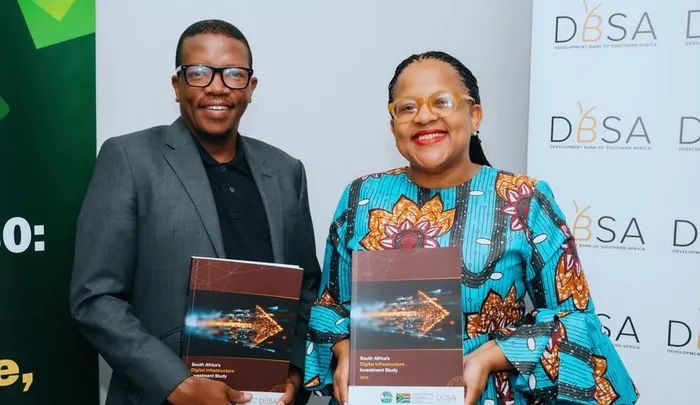
Dr. Tshepo Feela, NPC Commissioner and the CEO od the DBSA, Boitumelo Mosako, at the launch of the Digital Connectivity Road Map at the DBSA Campus.
Image: Supplied
South Africa has taken a major step toward closing its digital divide, with the Development Bank of Southern Africa and the National Planning Commission (NPC) unveiling a R142 billion Digital Connectivity Investment Roadmap aimed at achieving universal high-speed broadband access by 2035.
The roadmap, released on Monday, provides a detailed, costed blueprint to expand digital infrastructure, strengthen institutional capacity and accelerate the country’s transition to an inclusive digital economy.
It aligns with key national and global frameworks, including the National Development Plan, SA Connect, the National Infrastructure Plan 2050 and the Sustainable Development Goals.
Developed through extensive research and modelling, the study translates policy ambition into a practical investment framework, identifying funding gaps, priority interventions and partnership opportunities needed to expand reliable, high-speed connectivity across the country.
NPC Commissioner Mark Swilling stated that the roadmap offers a shared foundation for coordinated action between government and the private sector.
“This roadmap provides the country with a current, comprehensive, costed view of what is required to bridge the digital divide and achieve universal access to digital connectivity by 2035,” Swilling said.
“It outlines a common, evidence-informed basis for coordinated planning across the public and private sector, in order to drive investment and delivery of the roadmap.”
The study applies international benchmarks, including the World Bank’s Beyond the Gap framework and the International Telecommunication Union’s standards for universal and meaningful connectivity.
Using scenario modelling and geographic mapping, it identifies areas where access remains limited and quantifies the scale of investment required under different economic conditions.
A key finding is that achieving universal high-speed access of at least 100 Mbps will require targeted infrastructure upgrades, greater investment in rural areas and a mix of technologies.
The roadmap takes a holistic view of the digital ecosystem, covering international connectivity, backbone and metro networks, data centres, spectrum systems and last-mile access.
However, it also highlights that infrastructure alone will not suffice. Affordability, digital skills and institutional capacity are identified as critical barriers, with income constraints remaining the primary obstacle to widespread adoption of broadband services.
DBSA CEO Boitumelo Mosako said the roadmap goes beyond policy by setting out a clear implementation framework.
“South Africa’s Digital Connectivity Investment Roadmap to 2035 goes beyond policy to deliver a clear implementation framework spanning spectrum reform, municipal capacity, digital skills, universal service, and demand-side support,” Mosako said.
To guide execution, the study outlines three potential investment pathways over the next decade. These include a mobile-centric, least-cost approach suited to constrained fiscal conditions; a hybrid model combining mobile and fibre infrastructure; and a fibre-dominant strategy designed to maximise capacity and competitiveness in a stronger economic environment.
Each pathway highlights trade-offs between cost, service levels and long-term economic returns, providing policymakers with options depending on fiscal realities and development priorities.
The roadmap also emphasises the importance of mobilising diverse funding sources, including public investment, public-private partnerships and blended finance mechanisms. Institutional reforms aimed at reducing regulatory and deployment barriers are seen as critical to attracting private sector participation.
Ultimately, the DBSA and NPC said the roadmap provides a practical platform for coordinated action, with the potential to unlock inclusive growth, improve service delivery and enhance long-term economic resilience.
BUSINESS REPORT