

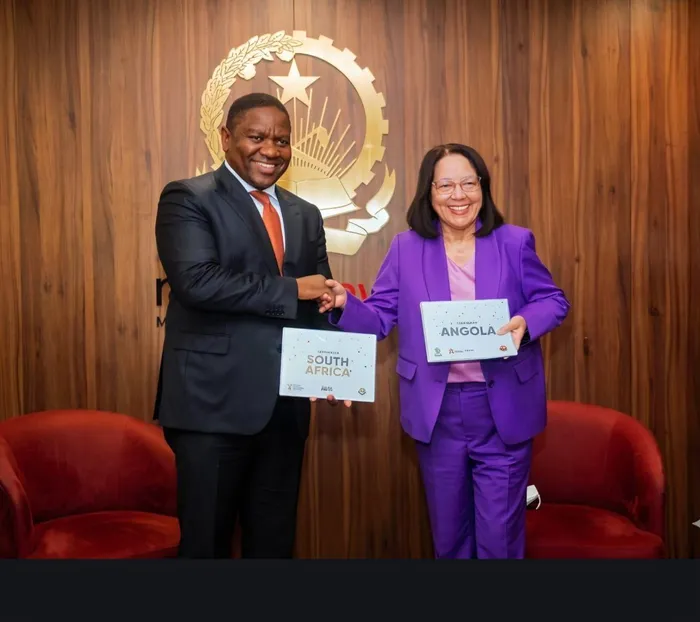
Tourism Minister Patricia de Lille concluded a bilateral meeting with her counterpart, Angola Tourism Minister Marcio de Jesus Lopes Daniel. The meeting culminated in the signing of the Action Plan on Tourism Cooperation 2026-2029.
Image: Supplied
South Africa and Angola have taken a major step toward strengthening economic and tourism ties, agreeing to remove capacity and frequency restrictions on both passenger and cargo flights between the two countries.
The breakthrough, reached during a high-level visit by Tourism Minister Patricia de Lille to Luanda on Friday, came into effect on 24 March 2026 and is seen as a significant move to unlock growth in travel, trade and investment across the region.
De Lille’s visit included bilateral engagements with Angola’s Tourism Minister, Márcio de Jesus Lopes Daniel, where both sides reaffirmed their commitment to deepening cooperation across multiple sectors.
The agreement effectively liberalises air access between South Africa and Angola, allowing airlines greater flexibility to increase flight frequencies and expand cargo operations without previous regulatory constraints.
This is expected to improve connectivity, reduce travel bottlenecks and stimulate demand for both business and leisure travel.
The Department of Tourism said the removal of restrictions will have immediate and far-reaching economic benefits. Increased flight availability is likely to lower costs, improve convenience for travellers and facilitate the faster movement of goods, particularly high-value and time-sensitive cargo.
Speaking during the visit, De Lille emphasised the broader economic significance of the move, noting that each additional flight represents an opportunity to deepen commercial ties and foster stronger people-to-people connections.
“Every additional flight between our countries is an opportunity for business, for tourism, and for deeper people-to-people connections,” De Lille said.
The aviation agreement forms part of a wider effort to enhance bilateral relations and position tourism as a key driver of inclusive economic growth. It is closely linked to a newly signed three-year Action Plan on Tourism Cooperation between the two countries, which aims to translate policy alignment into tangible economic outcomes.
The Action Plan outlines priorities including tourism investment, joint destination marketing and skills development. Improved air connectivity is seen as the backbone of these initiatives, enabling easier access for tourists and investors while supporting the development of new tourism infrastructure and services.
Angola has emerged as an increasingly important source market for South Africa’s tourism sector. Visitor numbers from Angola reached more than 41,000 in 2025, marking a 10% year-on-year increase.
The department believes that easing air travel constraints will accelerate this growth trajectory and unlock untapped demand.
At the same time, the agreement is expected to encourage South African travellers to explore Angola, supporting a more balanced exchange of tourism flows between the two nations.
Joint marketing campaigns are planned to promote both destinations as accessible and high-value travel options within the Southern African region.
Beyond tourism, the expanded air access is also set to strengthen trade and investment linkages. Businesses in sectors such as mining, energy, agriculture and retail stand to benefit from improved logistics and more efficient cross-border movement.
“Tourism is not only about travel, but also about investment, jobs, and opportunity. Through this partnership, we are unlocking new pathways for shared prosperity between South Africa and Angola,” De Lille said.
The timing of the agreement aligns with broader efforts to enhance regional integration within the Southern African Development Community (SADC), where Angola is the second-largest economy. Improved connectivity between key markets is viewed as essential to unlocking intra-African trade and supporting the goals of the https://businessreport.co.za/companies/2026-03-05-east-africa-leads-continental-trade-revival-as-infrastructure-regional-integration-gain-pace/.
The visit also highlighted the role of major international events in driving tourism growth. De Lille attended the launch of the Luanda E1 Grand Prix, underscoring how global sporting events can elevate destination visibility, attract investment and stimulate local economies.
As both countries move from dialogue to implementation, the removal of flight restrictions stands out as a concrete and immediate step toward building a more connected and competitive regional tourism economy.
With fewer barriers in the skies, South Africa and Angola are now positioning themselves for stronger growth, deeper collaboration and expanded opportunities across tourism, trade and investment.
BUSINESS REPORT