

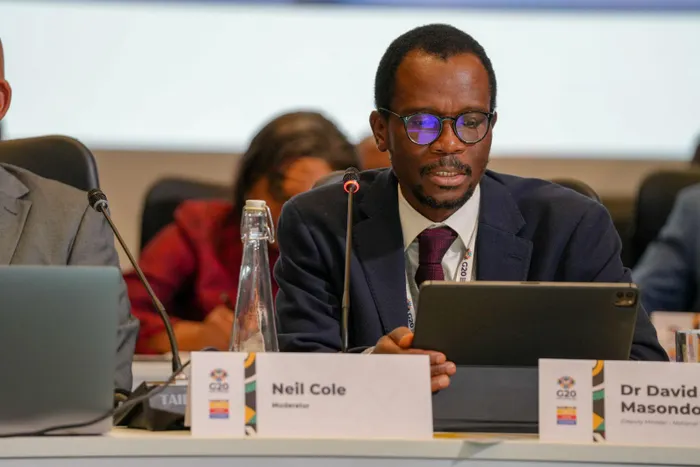
David Masondo, PIC chairperson and deputy finance minister. The Daybreak case also highlights broader compliance issues within the PIC’s assets under management.
Image: GCIS
The Public Investment Corporation (PIC) is facing renewed scrutiny over its troubled investment in Daybreak Foods, with Parliament raising concerns about governance failures, weak due diligence and ongoing instability at the poultry producer.
South Africa’s largest asset manager of public funds injected more than R1.7 billion into Daybreak, a vertically integrated poultry business on the brink of liquidation.
During a briefing to the Standing Committee on Finance on Tuesday, PIC executives outlined the extent of challenges at Daybreak, which has been flagged by the Auditor-General for material irregularities linked to insufficient due diligence at the time of investment.
This comes as assets under the PIC management have grown from R2 trillion to R3.6trln.
PIC chief financial officer (CFO) Batandwa Damoyi told MPs that the Auditor-General identified 16 remedial actions relating to the Daybreak investment.
While six of these have been completed and verified, ten remain in progress, highlighting the ongoing effort required to stabilise the investment and address governance shortcomings.
At the heart of the issue is the finding that proper due diligence processes were not fully followed when funds were disbursed. This failure has had far-reaching consequences, with Daybreak now placed under business rescue, a process aimed at restructuring financially distressed companies.
"We had the audit finding in relation to the investment decisions that had been taken, which the auditor general felt were not aligned with section 10.4 of our PIC Act. And the two investments that were identified, which led to a material irregularity that was identified, is Enable Capital and Daybreak," Damoyi said.
The PIC is significant losses after investments in Enable Capital were involved in alleged fraud of at least R500 million, with reports of a R100m loss.
"If I take you to the specific material irregularities on Daybreak," said Damoyi. "It related to the insufficient due diligence that was performed on these investments when [funds] were disbursed."
Damoyi also confirmed that the corporation is working closely with the business rescue practitioner and chief restructuring officer of Daybreak, holding weekly meetings to monitor progress and explore recovery options.
The instability at Daybreak has been underscored by a series of executive suspensions, with the latest involving the company’s CFO, Aubrey Dali, who was placed on precautionary suspension earlier this month.
According to PIC CEO Patrick Dlamini, the suspension followed allegations of gross misconduct and is currently under investigation.
"We were advised by the business rescue practitioner that it is actually on the back of the allegation of gross misconduct against the CFO and that the investigation into this are fully underway, and we are waiting progress accordingly," Dlamini said.
Parliamentarians expressed concern that these recurring issues point to deeper systemic weaknesses, both within Daybreak and in the PIC’s oversight of its investments.
Questions were raised about why warning signs were not detected earlier and whether internal controls are sufficient to prevent similar failures in future.
Damoyi acknowledged that part of the problem lay in how investment conditions were structured. In one instance, security for the investment was only meant to be registered after funds had already been disbursed — a “condition subsequent” that the Auditor-General flagged as risky.
The PIC has since corrected this by ensuring that the necessary security has now been registered.
The Daybreak case also highlights broader compliance issues within the PIC’s assets under management. Over the past three years, the entity has repeatedly received audit findings related to non-compliance with investment processes, even as its financial statements remained clean.
Committee members argued that the problem is less about policy design and more about enforcement.
ANC MP Seaparo Sekoati noted that many of the findings relate to situations where policies existed but were not properly followed, pointing to what they described as “human error” and weak accountability mechanisms.
Beyond governance concerns, the Daybreak situation raises questions about the financial implications for public funds managed by the PIC, including those of the Government Employees Pension Fund. With the company under business rescue, the recovery of invested capital remains uncertain.
Dlamini emphasised that the PIC is committed to salvaging value where possible, while also learning from the experience to strengthen its investment processes. He said improving early intervention in distressed investments is a key priority, including enhancing the corporation’s turnaround capabilities to identify risks sooner.
BUSINESS REPORT