

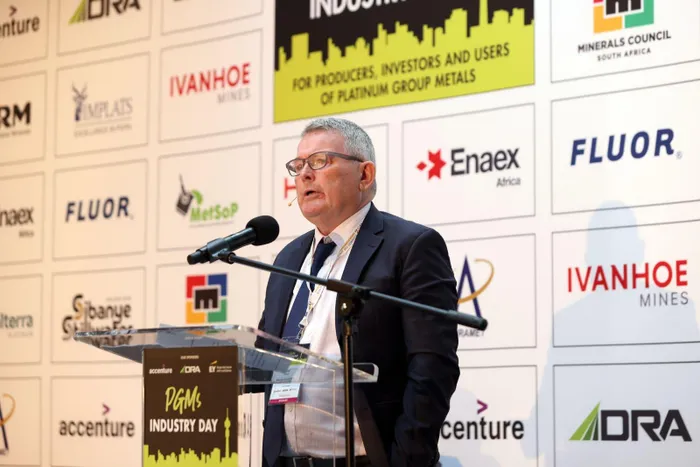
Minerals Council South Africa president Paul Dunne speaking at the Joburg Indaba on Thursday.
Image: Supplied
Tawanda Karombo
South Africa’s mining industry has warned that policy uncertainties, rising costs and infrastructure constraints continue to threaten investment and growth, signaling a willingness to work constructively with government on reforms and easing industry hold-backs.
Mining constitutes a key revenue and foreign currency earner for South Africa, especially with gold prices elevated and platinum grpup metals (PGM) prices holding fort. Other minerals produced in South Africa such as manganese, iron ore and coal are also critically in demand.
PGM miners, roiled by low prices in the past few years, had been forced to restructure, retrench and limit capital investment. However, currently favourable prices and a rosy outlook for PGM has breathed fresh impetus for the sector although policy concerns are seen having an impact on further investment prospects for the sub-sector.
Speaking at the Joburg Indaba on Thursday, Minerals Council South Africa president Paul Dunne said the industry was engaging President Cyril Ramaphosa’s administration on key legislative and policy issues. These include the the proposed Mineral Resources Development Bill, chrome export restrictions and the rollout of a national mining cadastre.
Dunne stressed that achieving “rational outcomes” is critical to supporting investment and job creation, warning against policy responses that misdiagnose underlying challenges.
“Energy availability and its cost are the foundation of a country’s competitiveness,” he noted, highlighting double-digit increases in electricity costs and calling for the liberalisation of the power grid to enable competition.
PGM, of which South Africa is the leading global producer alongside others such as Zimbabwe, where SA producers Impala Platinum and Sibanye-Stillwater have operations.
“Hard commodities in general and PGM in particular have a very bright future ahead and in order for South Africa to benefit fully, obstacles need to be removed and not created,” said Dunne.
“Mining sector is prepared to work with government to achieve pragmatic and practical outcomes (and) policy needs to be coherent not disjointed, and the narrative needs to be clear.”
The South African PGM sector employs around 170,000 workers out of the mining sector’s total workforce of 470,000. The mining sector also contributes 6.2% to South Africa’s GDP and accounts for R816 billion in exports—roughly 45% of the country’s total.
Corporate tax contributions from the mining sector amount to about R31bn, constituting about 10% of total collections while mining companies represent approximately 35% of the JSE Top 40 by market capitalisation.
The South African mining industry has persistently voiced concerns about the initial draft of the Mineral Resources Development Bill, arguing that it does not adequately support the level of investment required to unlock the sector’s full potential.
While the Council has submitted detailed proposals, Dunne said there are “positive signals” from government and expressed cautious optimism that industry concerns will be addressed in a revised draft.
Mining executives have identified regulatory uncertainties, delays in licensing approvals, crime and corruption, and deteriorating logistics and energy infrastructure as key deterrents to investment within the sector.
The capital-intensive nature of the key industry also worsens the situation, with new projects requiring at least R20bn and up to a decade to develop—funding that depends heavily on investor confidence.
“Providers of capital will not put their money into risky jurisdictions where returns are threatened by regulatory uncertainty, crime and corruption and failing infrastructure. At the very least, the cost of capital increases significantly rendering projects unviable that otherwise would proceed,” Dunne said.
André Lourens, economist for the Minerals Council has also described possible implications of the US-Israel war on Iran. Lourens said “global geopolitical tensions are likely to have broader macroeconomic implications” for commodity heavy countries such as South Africa.
He said heightened uncertainty could prompt the South African Reserve Bank to adopt a more cautious stance, potentially delaying further interest rate cuts and keeping borrowing costs elevated.
At the same time, commodity markets are showing mixed signals.
Gold prices have strengthened amid safe-haven demand, benefiting producers, but demand-driven commodities such as iron ore and coal could come under pressure if global trade and industrial activity weaken.
“The conflict is also likely to influence commodity prices. We are already observing elevated gold prices, as heightened geopolitical risk drives safe-haven demand,” Lourens said.
“While this is supportive for gold producers, increased geopolitical uncertainty could weigh on demand-driven commodities such as iron ore and coal, particularly if global shipping activity and industrial demand are adversely affected.”
BUSINESS REPORT