

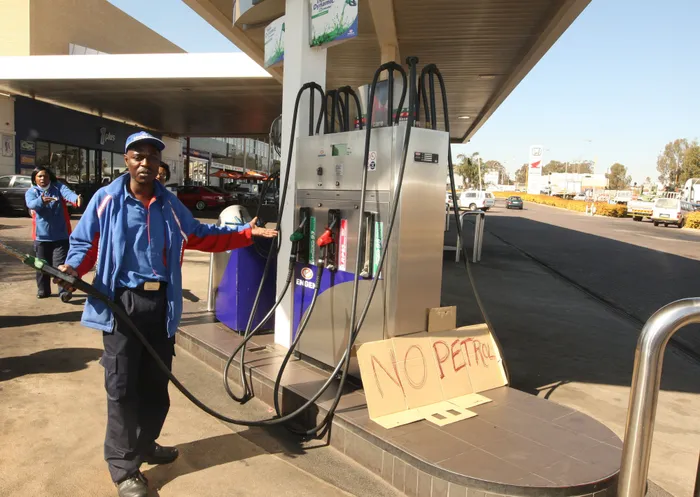
Market participants say that if shipping routes are constrained or insurance costs spike further, South Africa could face delays in fuel deliveries, tighter supply conditions, and rising logistical costs, all of which increase the risk of localized shortages.
Image: Simphiwe Mbokazi/Independent Newspapers
Concerns are mounting in the market that South Africa could face fuel shortages and even rationing in the coming months, as the ongoing conflict in the Middle East continues to disrupt global oil supply chains and drive prices sharply higher.
The anxiety comes despite government assurances that fuel supply remains stable in the immediate term.
The Department of Mineral and Petroleum Resources has reiterated that fuel consignments secured before the recent escalation in geopolitical tensions are currently being delivered and should sustain national demand over the next few weeks.
However, industry stakeholders and analysts warn that the situation could deteriorate rapidly if the conflict persists or worsens.
At the heart of the concern is South Africa’s heavy reliance on imported crude oil and refined petroleum products. As a net importer, the country is highly exposed to global supply shocks, particularly those affecting key shipping routes in the Middle East, a region that accounts for a significant share of global oil production.
Recent developments have already seen crude oil prices surge above $100 per barrel, with volatility expected to remain elevated. The conflict has raised fears of disruptions in critical maritime corridors, including the Strait of Hormuz, through which a substantial portion of the world’s oil supply passes.
Market participants say that if shipping routes are constrained or insurance costs spike further, South Africa could face delays in fuel deliveries, tighter supply conditions, and rising logistical costs, all of which increase the risk of localized shortages.
“Distribution networks, agricultural supply chains and retail logistics all become more costly to operate,” said Dr Ernst van Biljon, head lecturer for supply chain management at IMM Graduate School.
“There could also be severe fuel shortages, meaning companies have to plan ahead to avoid production shutdowns and supply chains not operating at optimal levels, which can lead to unhappy customers.”
The prospect of fuel rationing, while not yet official policy, is increasingly being discussed in industry circles as a contingency measure. Rationing could be introduced to manage limited supply and ensure that critical sectors such as transport, agriculture, and emergency services continue to operate.
Government has acknowledged these risks, noting that it is working closely with industry players to diversify supply sources and strengthen strategic reserves. Efforts are also underway to enhance storage capacity and accelerate infrastructure investments aimed at improving long-term energy security.
Nevertheless, the short-term outlook remains uncertain.
Economists warn that even without physical shortages, the impact of sustained high oil prices will be felt across the economy. Rising fuel costs are expected to feed into higher transport and production costs, putting upward pressure on inflation and further straining consumers already grappling with a high cost of living.
The transport and logistics sector, in particular, is seen as vulnerable. Any disruption in fuel availability could have knock-on effects on the movement of goods, potentially affecting supply chains and economic activity more broadly.
Business leaders have urged calm, cautioning against panic buying, which could exacerbate supply pressures. At the same time, they are calling for clear communication from authorities and contingency planning to mitigate potential disruptions.
For now, government maintains that there is no need for alarm, emphasising that current supply levels are adequate and that systems are in place to respond to emerging risks.
But as the conflict in the Middle East shows little sign of easing, the question facing South Africa is not whether the global energy shock will have an impact, but how severe and prolonged that impact could become.
If the situation escalates further, the country may find itself navigating a delicate balance between managing supply constraints and shielding its economy from the full force of a global oil crisis.
Earlier this week, DA spokesperson on mineral and petroleum resources James Lorimer said the Minister of Minerals and Petroleum Resources' failure to confirm whether two months' supply of transport fuel held in reserve at any one time, as mandated by law, raises serious concerns.
"If it is the case that the two months' supply is not available, there needs to be an urgent plan to make up the shortfall and maintain it in the future," Lorimer said. "If there's the slightest possibility of fuel shortages, we need to know far in advance so that citizens and businesses can prepare measures to cope."
BUSINESS REPORT