

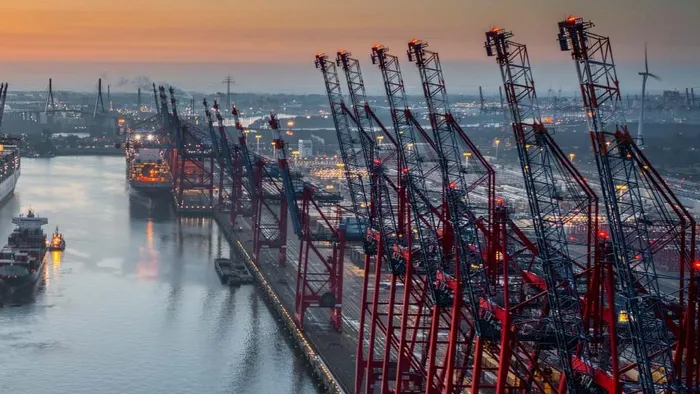
The report finds that globalisation has not retreated as sharply as many feared. Instead, it says the world’s level of globalisation has held steady near record highs despite rising political and economic uncertainty.
Image: Supplied
Globalisation remains firmly intact despite escalating geopolitical tensions, rising tariffs and mounting uncertainty over global trade policy, and South Africa remains an important participant in these international economic flows, according to the latest DHL Global Connectedness Report 2026.
The report, released by logistics giant DHL in partnership with New York University Stern School of Business on Thursday, finds that globalisation has not retreated as sharply as many feared. Instead, it says the world’s level of globalisation has held steady near record highs despite rising political and economic uncertainty.
Drawing on more than nine million data points tracking international flows of trade, capital, information and people, the study provides one of the most comprehensive assessments of how deeply countries remain integrated into the global economy.
In the report’s ranking of 180 economies, South Africa places 53rd globally, highlighting the country’s continued participation in global trade and investment networks even as its domestic economy faces slow growth and structural challenges.
While the country remains one of Africa’s most connected economies, its mid-table ranking suggests significant scope to deepen trade, investment and information flows. Strengthening logistics networks, improving trade infrastructure and reducing barriers to cross-border commerce could help South Africa capture a larger share of global trade.
The report measures globalisation on a scale from 0% — representing a world with no cross-border flows — to 100%, where borders and distance have no impact on economic activity.
By this measure, globalisation stood at 25% in 2025, matching the record level first reached in 2022. The findings suggest that, despite widespread concerns about economic fragmentation, international flows have remained surprisingly resilient.
According to John Pearson, the stability of global connections underscores the importance of international cooperation.
“Globalisation is holding its ground — and that alone speaks volumes about its value,” Pearson said. “From poverty to climate change, the world’s biggest challenges can only be solved through global thinking.”
For South Africa, which depends heavily on international trade for exports such as minerals, manufactured goods and agricultural products, the continued resilience of global flows provides important support for economic activity.
Across Sub‑Saharan Africa, the report highlights growing integration into global trade and investment networks, although levels of connectedness still vary widely between countries.
Several economies in the region have recorded notable improvements in their global integration over the past two decades.
Namibia ranks among the top three countries globally for long‑term increases in connectedness since 2001, while Mozambique has also made significant gains over the same period.
More recently, Nigeria and Zambia have posted some of the biggest improvements since 2022, reflecting rising momentum in trade, investment and cross-border mobility.
Within the region, other Sub‑Saharan African countries with relatively higher overall ranks include Seychelles (40th globally), Mauritius (65th), and Namibia (68th). Other regional peers include Ghana (97th), Nigeria (100th), Mozambique (107th), and Kenya (119th).
The report also highlights the recovery of international travel following the collapse caused by the Covid-19 pandemic.
Across Africa, tourism has rebounded strongly. Data from the United Nations shows that international tourist arrivals to the continent increased by 17% in 2025 compared with 2019, marking the second-largest recovery among global regions after the Middle East.
The revival of tourism flows is helping restore cross-border mobility and strengthen economic ties across the region.
Despite increasing tensions between major powers such as the United States and China, the report finds little evidence that the global economy is splitting into rival geopolitical blocs.
“Global goods trade is still projected to grow at roughly the same pace during 2026–29 as it did over the preceding decade (2.6% on average),” reads the report.
“Global trade can continue to grow despite U.S. tariff hikes because most trade does not involve the US (13% of imports went to the U.S. in 2025 and 9% of exports came from the US) and most other countries are not raising their own tariffs. Instead, many countries are striking new trade agreements to secure access to alternative markets.”
According to Steven A. Altman, the political debate around globalisation often exaggerates the scale of change.
“The politics and policy surrounding globalisation are much more volatile than the actual flows between countries,” Altman said. “The risks to globalization are real, but so is the resilience of global flows.”
BUSINESS REPORT